
Tech Deep Dive: Recycling Flows and Recovery Limits for Key Strategic Materials
The critical materials narrative often treats recycling as a future escape hatch from mining dependence. In practice, physical flows, process chemistry, and the age profile of installed assets constrain what recycling can actually deliver by 2030 and into the 2040s.
For strategic metals such as lithium, cobalt, nickel, copper, rare earth elements (REEs), tungsten, and platinum group metals (PGMs), the core operational question is not whether recycling technology exists, but how much recoverable material will be available, at what quality, and at what energy and compliance cost. This is where optimistic circularity narratives collide with facility‑level realities.
Materials Dispatch’s view is straightforward: in the 2020s and early 2030s, recycling is primarily a risk‑buffering and by‑product optimization tool, not a structural replacement for primary supply. The limiting factor is less laboratory efficiency and more the geometry of product lifetimes, scrap logistics, and regulatory friction.
1. Market Scale: Fast Growth, Limited Structural Displacement
Monetary growth in recycling markets is significant, but it does not translate linearly into displaced primary mining. Several segments illustrate this divergence.
Industry data indicates that the precious metals e‑waste recovery segment was valued around US$6 billion in 2024 and is projected to reach roughly US$7.4 billion by 2030, implying a modest single‑digit compound growth rate. This reflects rising volumes of end‑of‑life electronics and higher recovery efforts for gold, silver, palladium, and other high‑value metals embedded in devices, but it still represents a small share of total global precious metal supply.
The broader metal recycling market, covering ferrous and non‑ferrous streams, is much larger. Estimates place its value at over US$70 billion in 2023, with projections above US$120 billion by 2030 at high single‑digit compound growth. This increase is driven by both additional tonnage and higher value per tonne, but it primarily reflects growth in bulk metals (steel and copper) rather than the most critical battery or rare metals.
Black‑mass recycling, focused on spent lithium‑ion batteries, is a smaller but faster‑growing niche. Market assessments suggest black‑mass processing could exceed US$5 billion by 2030, from a much lower base today. This is the critical midstream link for recovering cobalt, nickel, manganese, and, increasingly, lithium from electric vehicle (EV) and stationary storage batteries.
On the long tail of strategic metals, a “rare metal recycling” cluster-covering elements such as tantalum, indium, and some rare earths-is projected in the hundreds of millions of dollars by the early 2030s. That scale underlines the core issue: in value terms this segment grows, but relative to primary mining of these elements, it remains supplementary.
In short, market growth signals rising activity and CAPEX, but not a fundamental inversion of the supply structure. Bulk scrap flows (steel, copper, aluminum) dominate recycling tonnage, while the most geopolitically sensitive metals remain tied to primary ore bodies.
2. Material Flows: Feedstock Geometry and the 2030 Constraint
Technical capability is only half the equation. The other half is whether material physically arrives at a recycling gate in a recoverable form. Here, two categories matter: prompt scrap and post‑consumer (end‑of‑life) scrap.
- Prompt (pre‑consumer) scrap arises during manufacturing — offcuts from rolling mills, machining chips, electrode off‑spec product, catalyst refurbishing. It is typically clean, segregated, and high‑grade, making recovery straightforward both technically and economically.
- Post‑consumer scrap comes from end‑of‑life vehicles, electronics, turbines, magnets, and infrastructure. It is heterogeneous, contaminated, and often physically entangled with plastics, ceramics, and other metals, significantly complicating extraction.
For strategic materials, the bulk of current recycling volumes still originate from prompt scrap and industrial take‑back (for example, spent PGMs catalysts) rather than mass post‑consumer flows. That skew is central to understanding realistic ceilings on recycled content in the 2020s.
For battery metals, the age profile is particularly constraining. EV batteries sold in the late 2010s and early 2020s have typical service lives on the order of a decade, with many units entering second‑life stationary applications before true end‑of‑life. As a result, the volume of spent EV packs available for recycling in 2030 remains modest relative to the size of the installed base and the upstream mining throughput supporting it.
Global modelling of clean energy transitions indicates that recycling capacity for batteries and critical minerals is being built ahead of this feedstock wave. Capacity growth for battery recycling has been reported at around 50% year‑on‑year in 2023, while end‑of‑life volumes lag. In effect, plants are emerging faster than scrap, creating an utilisation gap in the near term.
This mismatch is most acute in jurisdictions where policy has driven aggressive build‑out of recycling capacity (for example, parts of East Asia and Europe) but where local end‑of‑life material is not yet abundant. In these regions, cross‑border sourcing of feedstock, merchant tolling, and competition for industrial scrap become central operational issues.
3. Recovery Performance by Metal Class
Recovery limits are highly metal‑specific. They depend not only on chemistry but also on how concentrated and “collectable” each metal is in its end‑of‑life form.
3.1 Platinum Group Metals (PGMs)
PGMs are the strongest positive case in strategic metal recycling. Industry statistics indicate that recycling contributes comfortably above 20% of annual platinum, palladium, and rhodium supply. Key drivers include the high intrinsic value of these metals and their relatively concentrated use in catalytic converters, chemical catalysts, and jewelry.
PGM recycling flows are dominated by:
- Automotive catalysts: Exhaust after‑treatment bricks are relatively easy to collect, have high PGM loadings, and are supported by established logistics and assay infrastructure.
- Industrial catalysts: Petrochemical and fertilizer plants operate under long‑term contracts that include catalyst take‑back and metal accounting.
- Jewelry and industrial scrap: High purity and known composition allow efficient refining routes.
Even here, that said, recycling does not eliminate the need for mining. The majority of PGMs still originate from primary sources, and incremental demand from fuel cells, hydrogen electrolysers, and specialty alloys maintains pressure on mine supply.
3.2 Gold, Silver, and Other Precious Metals
Gold and silver enjoy high recovery rates from jewelry and bullion, but their recovery from electronics and industrial applications is structurally constrained. Thin coatings, trace‑level use in connectors, and dispersion across billions of consumer devices create a collection and concentration problem more than a chemistry problem.
Market estimates for precious metals e‑waste recovery reaching the mid‑single‑digit billions of dollars by 2030 highlight robust commercial activity, but these numbers remain modest compared to annual primary gold and silver production. The vast majority of metal embedded in low‑value electronics still ends up in residual waste or in metallurgical streams where only a fraction is ultimately captured.
The key operational friction is economic: recovering milligrams of gold from mixed, flame‑retarded plastics and base metal boards is technically achievable through advanced hydrometallurgy and smelting, but the cost and environmental controls required push many potential recovery routes below economic cut‑off, especially in jurisdictions with stringent emissions standards.
3.3 Copper, Nickel, and Cobalt
Copper has long been a recycling workhorse. Scrap copper from wiring, motors, and industrial processes feeds a mature ecosystem of mechanical sorting, smelting, and electrorefining. For many economies, recycled copper provides a large share of refined copper supply, particularly from construction and industrial scrap.
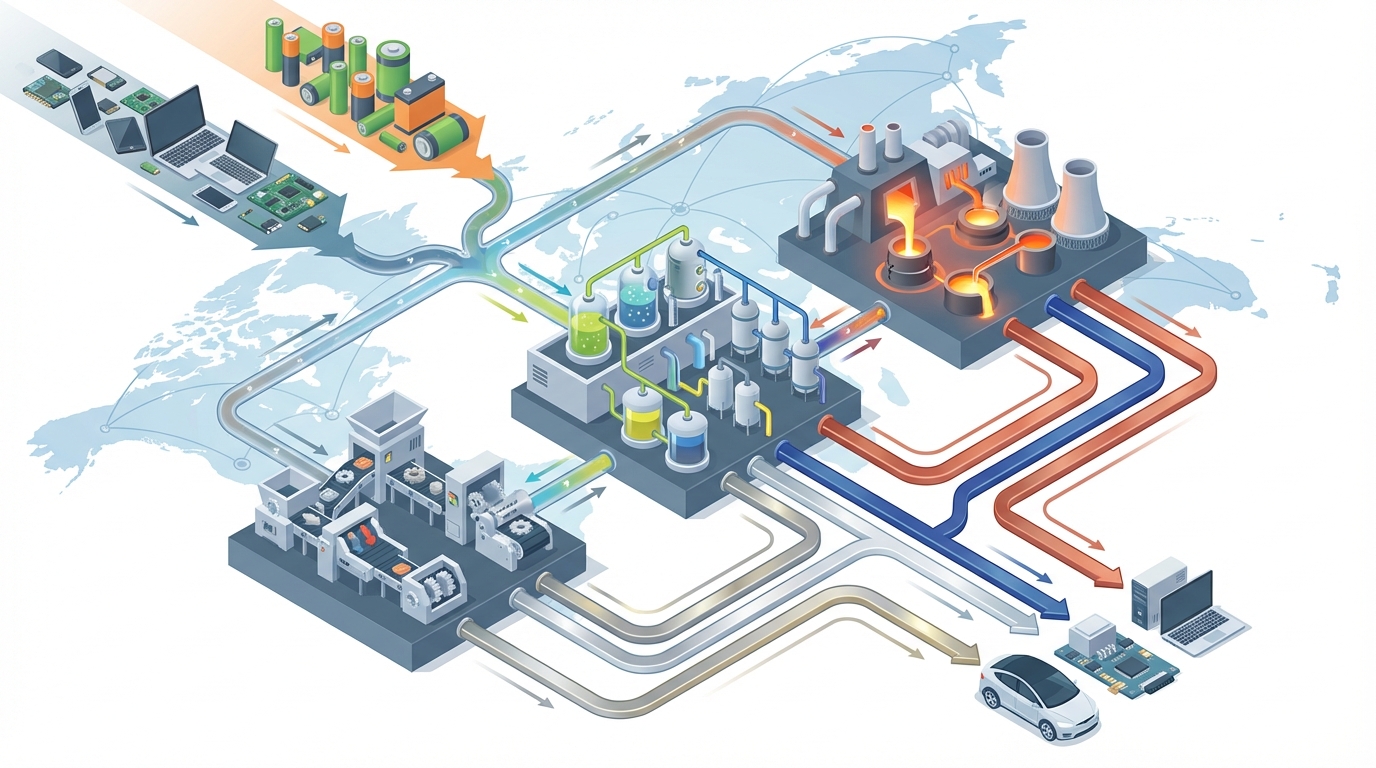
Nickel and cobalt recycling historically derived from stainless steel, superalloy scrap, and refinery intermediates. The emergence of battery black mass adds a new high‑grade source, particularly for cobalt. Hydrometallurgical circuits designed for sulphide concentrates have been adapted and, in some cases, purpose‑built for black‑mass leach and recovery.
Long‑term modelling under ambitious climate policy scenarios suggests that recycling could reduce the need for new mine development by roughly 40% for copper and cobalt, and around 25% for nickel and lithium, by 2050. These figures hinge on full deployment of collection systems, mature recycling infrastructure, and substantial technological progress. By 2030, the actual displacement is materially lower, limited by the pace at which EV fleets, renewable assets, and new grid infrastructure reach end‑of‑life.
3.4 Lithium and Graphite
Lithium and graphite sit at the difficult end of the recycling spectrum. Current lithium‑ion battery recycling technologies typically achieve overall recovery rates in the 40-60% range, with high efficiency for cobalt and nickel but much more limited capture of lithium and graphite.
Hydrometallurgical flowsheets often leach and recover transition metals as mixed sulphates or sulphides while treating lithium as a secondary product, for example via precipitation as lithium carbonate or lithium phosphate. Graphite is frequently burned for energy in pyrometallurgical routes or ends up in residues where recovery is technically possible but rarely economic at scale.
Regulatory pressure is starting to change the calculus. The European Union’s Battery Regulation (Regulation (EU) 2023/1542) sets binding recovery efficiency targets, including 50% lithium recovery from waste batteries by 2027 and 80% by 2031, alongside high targets for cobalt, nickel, and copper. These targets force process developers to focus on lithium and graphite recovery, not just high‑value transition metals, but commercial deployment at scale is still at an early stage.
3.5 Rare Earth Elements (REEs) and Other Criticals
Rare earth recycling remains marginal in absolute terms, despite intense policy interest. The difficulty is not the chemistry — solvent extraction and ion exchange can separate rare earths to high purities — but the combination of low concentrations, magnet miniaturisation, and the complexity of recovering magnets and phosphors from devices without prohibitive manual labour or contamination.
Emerging industrial flows include magnet swarf from machining of NdFeB magnets, end‑of‑life wind turbine generators, and EV traction motors. These streams offer higher grades than dispersed consumer applications and are the focus of pilot hydrometallurgical and molten‑salt processes. Even so, current rare earth recycling contributes only a negligible fraction of global supply, with primary production in China, the US, and Australia dominating.
For tungsten, molybdenum, and tantalum, recycling from tool steels, carbide inserts, and capacitors is more established. However, these flows are tightly linked to industrial scrap rather than broad consumer end‑of‑life streams, again limiting scale relative to primary mining.
4. Technology Deep Dive: From Shredders to Hydromet Cells
Recycling technologies can be grouped into mechanical, pyrometallurgical, hydrometallurgical, and emerging direct‑recycling processes. Each has characteristic recovery limits, energy demands, and environmental footprints.
| Technology Route | Typical Role | Recovery Profile | Key Constraints |
|---|---|---|---|
| Mechanical (shredding, sorting) | Pre‑treatment, liberation, scrap upgrading | Wide range (single digits to >70%) depending on material purity | Material mixing, fines losses, limited element‑specific separation |
| Pyrometallurgical | Smelting, high‑temperature refining | Variable, often 20-60% for complex multi‑metal feeds | High energy use, off‑gas treatment, limited lithium/volatile element capture |
| Hydrometallurgical | Leaching, solvent extraction, precipitation | Frequently above 40% and rising; best‑in‑class battery flowsheets claim >95% of contained metals | Reagent consumption, effluent management, slower kinetics, complex SX circuits |
| Direct recycling / re‑manufacturing | Cathode relithiation, magnet reprocessing | Potentially high value retention with lower energy input | Strict feed quality requirements, product qualification, still early‑stage |
4.1 Mechanical Pre‑Treatment and Sorting
Virtually every recycling chain starts with some form of mechanical pre‑treatment: shredding, milling, screening, magnetic separation, eddy‑current sorting, and density or optical sorting. These steps liberate metals from casings and substrates, concentrate high‑value fractions, and reduce transport volumes.
AI‑enabled optical sorters and robotic disassembly systems are increasingly deployed in e‑waste and battery dismantling lines. Their role is less about thermodynamic efficiency and more about reducing contamination, improving worker safety, and stabilising feed quality into downstream chemical processes.
4.2 Pyrometallurgy: Scale with Selectivity Trade‑Offs
Pyrometallurgical processes — furnaces, converters, and rotary kilns operating at hundreds to over a thousand degrees Celsius — offer robust throughput and flexibility. They can treat heterogeneous scrap, destroy organics, and produce metallic alloys or mattes that are amenable to further refining.
In PGM and precious metals recycling from autocatalysts, integrated smelter‑refinery complexes combine high‑temperature furnaces with precious metal refining circuits, achieving high recovery rates for PGMs while co‑producing base metals. For black mass, some flowsheets rely on smelting to produce a cobalt‑nickel alloy, with lithium reporting to slag or off‑gas unless specifically captured.
The key trade‑offs are energy intensity and selectivity. High‑temperature processes often struggle with light elements such as lithium and can volatilise halogens and organic contaminants, necessitating sophisticated off‑gas cleaning. Environmental regulations on dioxins, fluorides, and heavy metal emissions tighten the operating envelope and raise compliance costs.
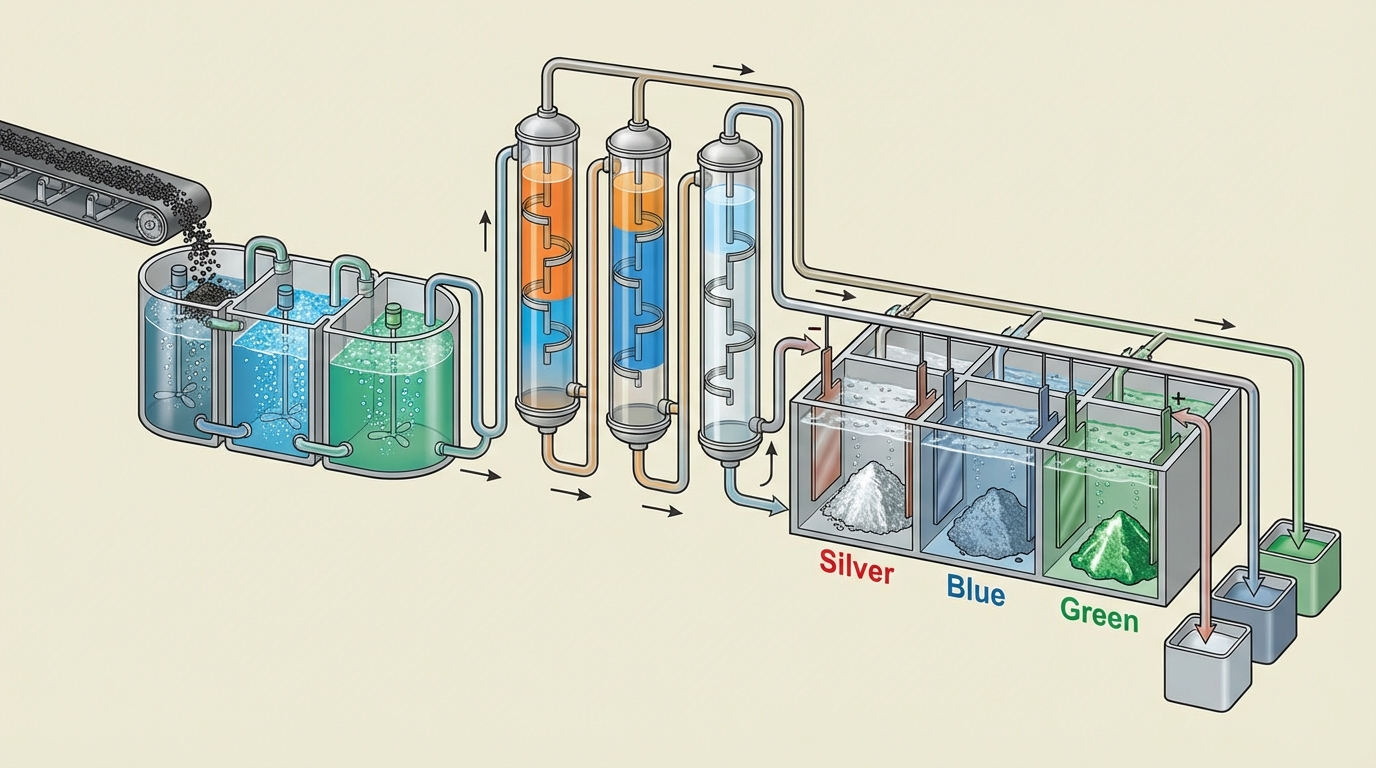
4.3 Hydrometallurgy: Selectivity with Wastewater Complexity
Hydrometallurgical routes use aqueous chemistry to leach metals into solution, followed by separation via solvent extraction (SX), ion exchange, precipitation, and electrowinning. For many strategic metals, hydrometallurgy is emerging as the midstream backbone of high‑efficiency recycling.
Battery black‑mass circuits typically include acid leaching (sulphuric, hydrochloric, or mixed systems), oxidation‑reduction control to separate manganese and iron, SX to split cobalt and nickel, and precipitation or crystallisation to produce battery‑grade sulphates or hydroxides. Some commercial technologies report over 95% recovery of cobalt, nickel, and manganese; lithium recovery remains more variable, depending on flowsheet design.
In rare earth recycling from magnet or phosphor scrap, hydromet circuits leverage the same SX chemistry used in primary REE separation, but often operate with more challenging impurity profiles (iron, aluminium, phosphates). The number of SX stages, organic losses, and aqueous effluent loads drive both CAPEX and OPEX.
Hydrometallurgy trades furnace energy for reagent manufacture and effluent treatment. Waste streams — acidified brines, sodium sulphate, fluorides, and organic residues from extractants — create non‑trivial tail management obligations under environmental permits.
4.4 Direct Recycling and Functional Material Recovery
Direct recycling aims to preserve the functional structure of materials rather than dissolving them to elemental form. Examples include relithiating spent cathode powders, recovering and re‑sizing graphite anodes, or reprocessing NdFeB magnet alloy into new magnets without complete chemical breakdown.
This approach can be far less energy‑intensive and preserve more of the embedded manufacturing value. However, it demands tight control of feedstock quality and consistent chemistries. Mixed chemistries (NMC, LFP, NCA), degradation products, and cross‑contamination from collection make standardisation difficult in real‑world streams.
Direct recycling is therefore best suited to vertically integrated systems with known product designs — for example, internal scrap from a cell manufacturer or closed‑loop agreements with specific OEMs — rather than heterogeneous municipal or cross‑OEM waste streams.
5. Physical and Economic Recovery Limits
The distance between theoretical recyclability and actual recovered tonnage is governed by three interacting limits: thermodynamic, design‑for‑recycling, and economic.
5.1 Thermodynamic and Process Limits
From a strictly physical perspective, complete recovery is rarely achievable. Dilution, mixing, side reactions, and phase equilibria lead to inevitable losses in slags, filter cakes, and off‑gases. Each additional increment of recovery typically demands disproportionate increases in energy, equipment complexity, or reagent consumption.
For example, chasing the last percentage points of lithium from a complex leach liquor may require multiple precipitation and impurity control steps, producing additional residues and raising effluent loads. Similarly, recovering trace gold or palladium from low‑grade slimes in a copper refinery is possible, but often uneconomic beyond a certain cut‑off grade.
5.2 Product Design and Dissipative Uses
Many strategic metals are used in inherently dissipative or low‑mass applications: thin‑film coatings, solder pastes, phosphors, catalysts with nano‑scale dispersion, and additives in alloys. Once dispersed at that scale and intermixed with organics or ceramics, recovery becomes either technically infeasible or grossly uneconomic.
Even where designs theoretically support recycling — such as magnets embedded in motors or generators — mechanical access can be a bottleneck. Extracting small magnets from sealed motors at scale without heavy manual labour remains challenging, despite robotics advances.
5.3 Economic Cut‑Offs and Down‑Cycling
Recycling economics hinge on the value per tonne of recoverable metal, less the cost of collection, logistics, processing, compliance, and financing. When elements are present at ppm levels in mixed waste, even high market prices may not offset the full cost stack.
This drives widespread down‑cycling. For example, mixed low‑grade copper and precious metal scrap may be routed to bulk smelters where copper is recovered efficiently but much of the precious metal content is dispersed into slags or dusts that are only partially retreated. Similarly, lithium in pyrometallurgical battery recycling often reports to slag that is not systematically reprocessed.
The result is a structural gap between theoretical circularity and what multi‑metal flowsheets deliver in practice. As a working heuristic for strategic planning, recycling behaves more as a high‑value capture mechanism for a limited set of elements than as a universal recovery engine.
6. Regional Capacity, Policy, and Compliance Friction
Recycling capacity build‑out is regionally skewed, and policy frameworks heavily influence which routes are feasible.
China currently holds a dominant position in battery pretreatment and material recovery, with projections pointing to more than 70% market share in these segments toward 2030. State‑backed enterprises are consolidating end‑of‑life EV batteries, with clear policy signals to retain critical metal value domestically. This concentration provides scale and learning‑curve advantages but also increases geopolitical dependence for downstream users of recycled materials.
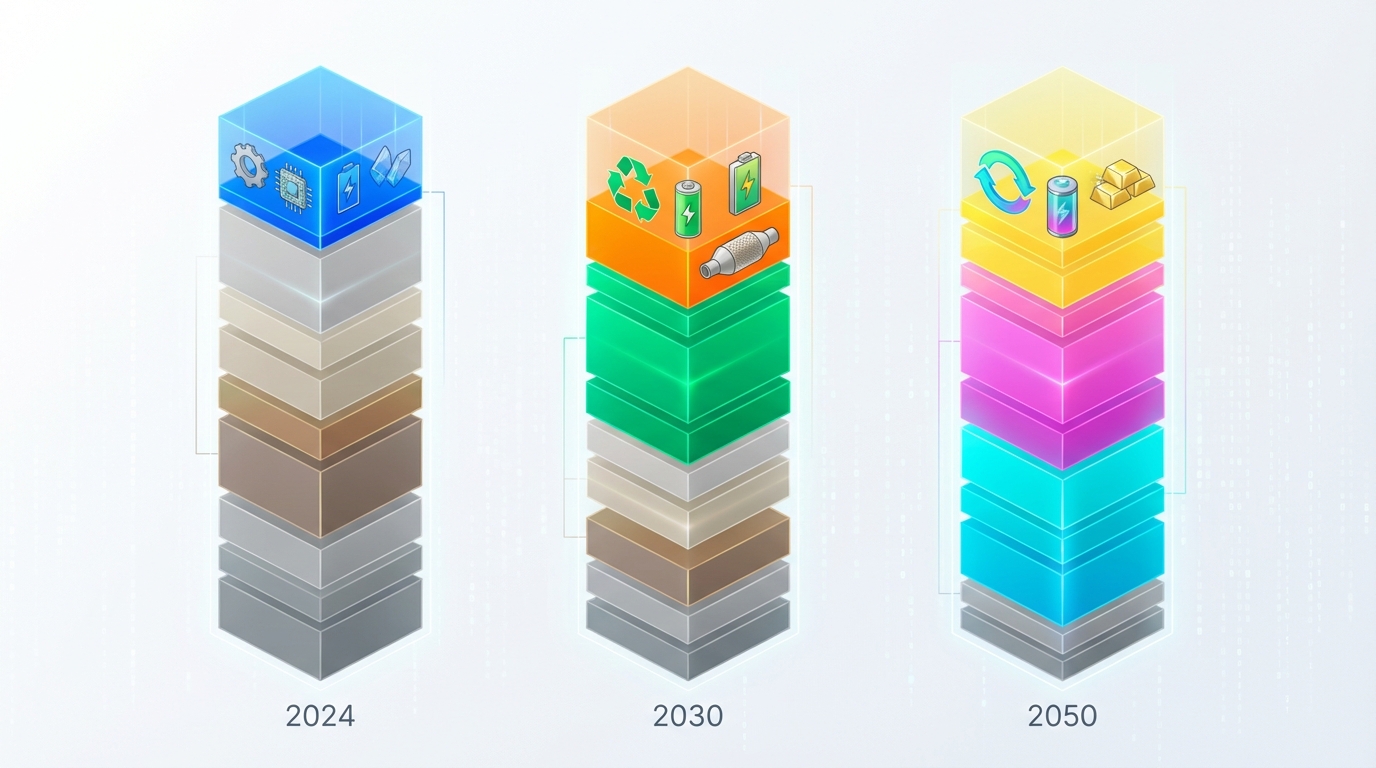
In Europe and the United States, announced recycling capacity for batteries and some critical metals is substantial, but modelling suggests that by 2040 it would only cover around 30% of the expected domestic end‑of‑life feedstock. This implies ongoing reliance on exports of waste or intermediate products, or on continued landfilling and energy recovery for a portion of complex waste, unless additional capacity or alternative routes emerge.
India and several Southeast Asian economies sit at the other end of the spectrum, with announced capacity projected to cover only a small share of anticipated feedstock by 2040. Informal recycling of e‑waste remains widespread, with associated safety and environmental risks, while formal hydromet and pyromet infrastructure is less developed.
Cross‑border shipment of hazardous waste for recycling is increasingly constrained by the Basel Convention and its amendments, as well as unilateral controls on “waste” exports. Classification disputes — whether a material is a recyclable product or a hazardous waste — introduce legal uncertainty, delay shipments, and raise storage and working‑capital requirements for recyclers.
At the same time, instruments such as the EU Battery Regulation, extended producer responsibility (EPR) schemes for electronics, and national critical mineral strategies are tightening obligations around collection and minimum recycled content. These regulations simultaneously create predictable feedstock flows and higher compliance complexity for operators across the chain.
7. Operational Risk and Failure Modes in Strategic Metal Recycling
Recycling facilities handling strategic metals face a distinct set of operational, environmental, and safety risks that shape feasible technology choices.
7.1 Safety and Process Stability
Battery and e‑waste handling introduces elevated fire and explosion risks. Lithium‑ion cells can undergo thermal runaway during shredding or storage, particularly if damaged or partially charged. Facilities rely on inerting (nitrogen, CO2), temperature monitoring, and stringent pre‑sorting to stabilise operations, adding to both CAPEX and OPEX.
Chemical hazards are equally material. Fluoride‑bearing electrolytes, if not properly neutralised and scrubbed, generate HF and other toxic compounds. Cyanide or aqua regia systems used in some precious metal recovery operations require tight containment and emergency response capabilities.
7.2 Environmental Compliance and Waste Management
Hydrometallurgical plants generate large volumes of process water and solid residues. Even when reagents are recycled internally, bleed streams containing dissolved metals, sulphates, fluorides, and organic extractants demand treatment to meet discharge standards. Solid residues, including filter cakes, neutralisation sludges, and slags, may qualify as hazardous waste, requiring secure disposal or further processing.
In the PGM and precious metal segment, dust control and fugitive emissions of arsenic, lead, and other toxic species are central permitting issues. Inadequate baghouse design or maintenance can rapidly erode regulatory goodwill and constrain throughput.
7.3 Feed Quality and Offtake Risk
Many recycling flowsheets are highly sensitive to feed composition. Shifts in battery chemistries (for example, growing penetration of LFP at the expense of high‑nickel NMC) change the value distribution in black mass and can undermine the business case of circuits optimised for cobalt and nickel recovery.
On the offtake side, downstream refineries and cathode/magnet makers increasingly demand tight impurity specifications. Delivering battery‑grade or magnet‑grade products from heterogeneous scrap requires consistent process control, rigorous sampling, and robust metal accounting. Failure to meet specifications can downgrade material to lower‑value outlets, eroding the economic rationale of high‑capex recycling assets.
8. 2030-2040 Scenarios: Where Recycling Changes the Supply Balance
Scenario analysis across metal classes reveals a clear pattern: recycling meaningfully alters supply‑demand balances in some segments, while remaining structurally peripheral in others, at least through 2030.
- PGMs and precious metals: Recycling already accounts for a significant share of PGM supply and a substantial share of gold from jewelry and bullion. Further incremental gains are likely, but the system is already close to its practical collection and processing ceiling.
- Copper, nickel, and cobalt: As EV fleets, grids, and industrial assets mature, post‑consumer scrap volumes become large enough for recycling to offset a material fraction of new mine requirements, especially under strong policy support. However, until the 2030s, primary mining remains the dominant supply pillar.
- Lithium and graphite: Even under optimistic technology trajectories and strict regulatory targets, recycling contributes a relatively small fraction of supply by 2030, with more impactful displacement only emerging in the 2035–2045 window as first‑wave EV packs retire in bulk.
- Rare earths and niche criticals: Recycling offers targeted relief for specific applications (magnets, phosphors, catalysts) but remains far from reshaping global supply, given the dominance of primary production and the fragmentation of end‑of‑life flows.
One structural insight stands out: in critical metals, recycling behaves more as a volatility dampener than a volume replacement. When integrated into metal balance modelling, high‑efficiency recycling reduces the amplitude of supply shocks and price spikes but does not eliminate dependence on new projects in politically or geologically constrained regions.
From an industrial resilience perspective, strategically located recycling capacity — near demand centres, powered by relatively low‑carbon grids, and embedded in transparent regulatory regimes — functions as critical infrastructure. It provides a backstop in disruption scenarios, shortens logistics chains, and offers options for rapid response to material bottlenecks, even if it cannot fully close the loop.
9. Conclusion: Realistic Circularity and the Role of Recycling in Strategic Metals
The emerging reality is more nuanced than the slogan of an imminent circular economy for critical materials. Physics, design choices, and economic thresholds impose firm ceilings on recoverable fractions, especially by 2030. Recycling already plays an indispensable role in PGMs, copper, and certain industrial scraps, and it is rapidly gaining importance in battery midstreams, but it does not erase the requirement for new primary supply in strategic metals.
The critical operational insight for the next decade is that capacity growth in recycling will continue to run ahead of post‑consumer feedstock in many regions, while regulatory intensity, product redesign, and offtake specifications raise the bar for process performance. Facilities that integrate robust mechanical pre‑treatment, flexible hydrometallurgical flowsheets, and disciplined environmental management are better positioned to convert nominal capacity into effective recovered tonnage.
For Materials Dispatch, recycling flows are treated as a dynamic but bounded component of the broader supply architecture. Continuous monitoring of policy shifts, technology performance, and lifetime distributions of critical‑metal‑bearing assets remains essential, as these weak signals will determine how far recycling can stretch its role in the strategic metals system beyond 2030.
Note on Materials Dispatch methodology Materials Dispatch integrates regulatory text monitoring (including instruments such as the EU Battery Regulation and MOFCOM directives), market and production data from agencies like the IEA and USGS, and end‑use technical specifications from OEMs and standards bodies. This triangulation supports a grounded view of how recycling technologies, material flows, and recovery limits interact across the full critical materials value chain.
Anna K
Analyst and writer at Materials Dispatch, specializing in strategic materials and natural resources markets.


