
Materials Dispatch has watched critical materials policy move from background noise to daily operational constraint. After COVID-era shipping failures, the 2022 nickel and gas crises, and China’s escalating export controls on gallium, germanium and graphite, procurement and compliance teams in partner organisations stopped asking whether raw materials policy matters and started asking which jurisdiction’s rules will quietly govern factory schedules and defence programmes. The emerging split between the United States and the European Union on minerals strategy is now the central fault line in that discussion.
The decisive shift in our own reading came when US officials began sketching out FORGE-style tools built around finance and reference prices at the same time that Brussels doubled down on the Critical Raw Materials Act (CRMA) with extraction, processing and recycling targets. Since then, the same upstream project – a rare earths deposit in Greenland, a graphite mine in Mozambique, a recycling hub in Germany – has been presented to Materials Dispatch under radically different assumptions depending on whether the buyer sits under US defence rules or EU ESG and CBAM regimes. What looked like gradual “de-risking” from China has instead hardened into a patchwork of overlapping and sometimes incompatible expectations.
Key points
- The current US-EU minerals landscape is neither full decoupling from China nor coherent Western alignment, but a patchwork of US speed/finance tools and EU regulatory conditionality.
- On the US side, the Forum on Resource Geostrategic Engagement (FORGE) and Project Vault lean on reference prices, adjustable tariffs and large-scale export finance to pull allied supply chains into a US-centric orbit.
- On the EU side, the CRMA’s 10% extraction, 40% processing and 15% recycling targets by 2030, combined with CBAM and strict ESG screens, prioritise traceability and circularity but slow deployment.
- Operationally, this split channels defence and some battery value chains toward US-aligned jurisdictions, while EU manufacturing remains structurally exposed to Chinese processing capacity and remote high-ESG projects such as Greenland’s Tanbreez.
- Forward-looking supply risks cluster around NdPr for permanent magnets, graphite for anodes, and a handful of REE and PGM projects where US finance and EU ESG standards may pull in opposite directions; all projections remain scenario-based and contingent.
FACTS: Regulatory architectures on each side of the Atlantic
US framework: FORGE, Project Vault and Ex-Im finance
The emerging US framework is built around an initiative described as the Forum on Resource Geostrategic Engagement (FORGE). Launched at a critical minerals ministerial in Washington, FORGE is presented as a plurilateral, US-led arrangement bringing together allied producer and consumer states (for example Australia, Canada, Chile and Japan have been mentioned in that context). Its core features, as currently described, include:
- Use of reference prices at different value-chain stages (from ore to refined oxides and metals) for selected strategic commodities such as rare earth elements (REEs), graphite and cobalt.
- Adjustable tariffs designed to enforce these reference prices against what Washington frames as “non-market” behaviour, with the potential to increase duties if export prices from China or other non-participants fall below specified thresholds.
- Backstopping finance through the US Export–Import Bank (Ex-Im), with policy material referring to a lending envelope of up to $100 billion to support projects aligned with US “energy dominance” and security of supply objectives.
- Integration with a strategic stockpiling initiative, Project Vault, framed as a Strategic Critical Minerals Reserve with a funding size described in the $10–12 billion range.
Project Vault’s stated focus is to underwrite security of supply for defence and aerospace platforms by holding material reserves in key inputs such as NdPr (for permanent magnets in systems like fighter aircraft and precision-guided munitions), graphite (for batteries) and selected platinum group metals and superalloy inputs (for turbine and engine components).
Timeline references linked to this US framework include clarification of FORGE membership and initial reference price setting during 2026, including an indicative NdPr oxide reference range described at $80–100/kg in contrast to a spot environment illustrated at $55/kg. The policy narrative positions this as a shield against perceived “dumping” from Chinese producers and a way to stabilise project economics for new North American, Australian and allied suppliers.
Operationally, existing US projects such as the Mountain Pass rare earths mine in California – described with a NdPr equivalent output of around 1,500 tonnes per year – are frequently cited as anchor assets for FORGE-aligned magnet supply chains. Policy material also links Ex-Im backing to overseas assets such as graphite operations in Mozambique (for example Syrah Resources’ Balama mine, with stated capacity around 200,000 tonnes per year), with the intention of channelling their output into US-based processing and manufacturing.
EU framework: CRMA, REsourceEU and CBAM
The EU approach is codified primarily through the Critical Raw Materials Act (CRMA), which entered into force in 2024. The CRMA sets quantitative benchmarks for the Union’s annual consumption of designated critical and strategic raw materials by 2030:
- 10% of annual consumption to be met by extraction within the EU.
- 40% to be met by processing (refining, smelting, chemical conversion) within the EU.
- 15% to be met by recycling within the EU.
These targets apply across a list of 34 raw materials classed as critical or strategic. To support delivery, the Commission has attached a REsourceEU Action Plan referencing around €3 billion in funding, complemented by approximately €2 billion in lending and guarantees from the European Investment Bank (EIB) and the European Bank for Reconstruction and Development (EBRD).
The CRMA also introduces the concept of “strategic projects”, which are eligible for accelerated permitting – with an indicative 12‑month period quoted for extraction projects – and enhanced access to public finance. However, a 2026 Special Report from the European Court of Auditors highlights that only a small fraction of candidate projects currently meet the CRMA’s environmental, social and governance (ESG) and permitting standards, with a figure of around 5% of sites cited. The same report notes that:

- 46% of surveyed stakeholders highlight “red tape and administrative inaction” as the principal barrier to CRMA deployment.
- 31% identify geographical constraints and lack of domestic reserves as a primary obstacle, entrenching reliance on non-EU ore and concentrates.
In parallel, the EU is phasing in the Carbon Border Adjustment Mechanism (CBAM), which imposes a carbon-based levy on imports in certain emissions-intensive sectors. Policy discussions have considered extending CBAM-style obligations or traceability requirements to cover a wider range of critical raw materials, particularly those used in battery, aluminium and steel value chains. For precious metals such as platinum and silver, CBAM-type mechanisms and CRMA traceability are expected to reinforce a “green premium” for compliant material.
An EU–US critical minerals agreement has been on the agenda since mid‑decade, aimed at aligning subsidy regimes and origin rules for clean tech supply chains. As of the 2026 horizon described in policy material, this negotiation is portrayed as constrained by CBAM design, differing ESG expectations and transatlantic disputes over industrial policy.
Shared and contested nodes: projects and materials in focus
Several upstream and midstream assets recur in both US and EU minerals discussions because they sit at the intersection of these architectures:
- Tanbreez rare earth project, Greenland: described as holding around 7 million tonnes of rare earth oxides (REO), with a significant neodymium–praseodymium (NdPr) share, and framed as a potential supplier of roughly 10% of future EU REE needs under some policy scenarios. The project is at exploration/development stage and would require substantial infrastructure investment, estimated in the low single‑digit billions of euros or dollars in available descriptions.
- Kvanefjeld uranium–REE project, Greenland: associated with a larger resource base but complicated by Greenland’s political stance on uranium, resulting in stalled development and reliance on memoranda of understanding that periodically expire and renew.
- Balama graphite, Mozambique (Syrah Resources): a large-scale flake graphite operation with stated nameplate capacity around 200,000 tonnes per year, already linked to US Ex-Im financing in public material. It is often cited in Washington as a non‑Chinese anchor for FORGE‑aligned anode supply chains.
- Aurubis recycling and smelting complex, Hamburg (Germany): presented as a European leader in multi-metal recycling, with around 50,000 tonnes per year of critical metal intermediates referenced in project descriptions, including silver and platinum-bearing streams relevant to photovoltaics and electronics.
- Stillwater palladium mine, Montana (USA): a palladium-dominant PGM mine with an output figure of roughly 45,000 ounces per year quoted in some analyses, and frequently included in US defence-oriented sourcing discussions.
- Ivanhoe’s Kipushi project, DRC: framed as a major cobalt–copper restart, with cobalt-equivalent output measured in the hundreds of thousands of tonnes per year in project literature, but entangled in geopolitical questions, including Chinese corporate participation and EU ESG screens.
China’s entrenched role is another uncontested fact base. Policy documents routinely reference Beijing’s dominant position in both mining and especially processing, with one statistic citing roughly 79% global market share in graphite (around 27 million short tons in 2024) and around 85% of global rare earths refining capacity. Export control moves on graphite in 2023–2024 are treated on both sides of the Atlantic as a live warning.
INTERPRETATION: A patchwork regime – speed versus sustainability
From an operational perspective, the regime that is emerging looks much less like clean “decoupling” from China and much more like a contested patchwork. The US is constructing a finance-led, speed-prioritising architecture, while the EU is constructing a rule-led, sustainability-prioritising one. Neither is fully aligned with the other; both still rely heavily on Chinese processing capacity in the near term.
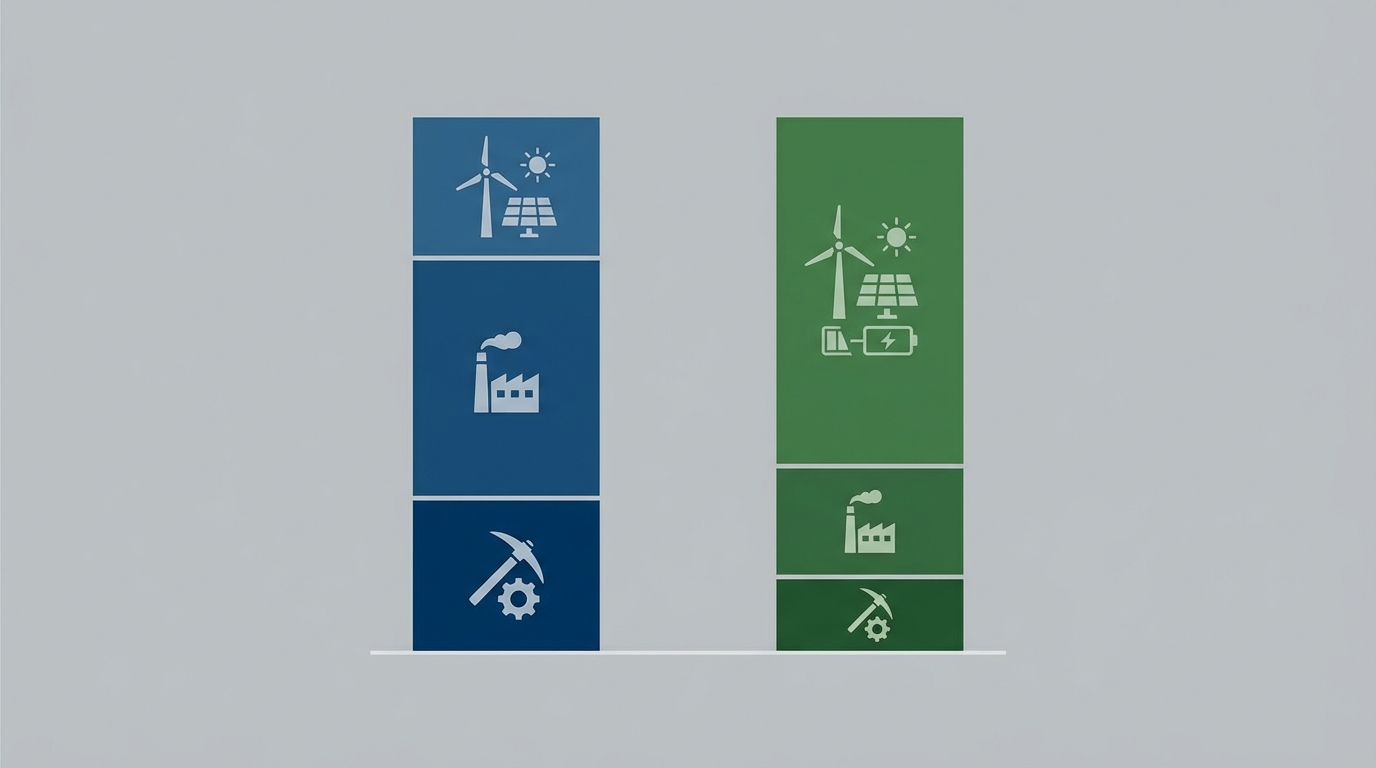
If FORGE and Project Vault are implemented roughly as described, US-aligned firms in defence, batteries and high-performance manufacturing are likely to enjoy more predictable access to key materials – but at the cost of accepting politically managed reference prices and tariff structures. That architecture is designed to pull volume from allied producers in North America, Australia, Africa and Latin America into value chains anchored in the US, even if that means tolerating higher near-term prices than a pure spot-market strategy.
The EU, in contrast, is leaning into CRMA, CBAM and ESG-heavy permitting. If this stance holds, European manufacturers gain credibility on traceability and sustainability, but risk slower access to new mine and refinery capacity. A CRMA world where only 5% of proposed strategic projects are presently qualifying, and where 46% of stakeholders point to administrative drag, sets the stage for multi‑year delays against the 2030 10/40/15 targets. In that context, EU supply chains are likely to remain dependent on Chinese or other third‑country refining even as rhetoric emphasises de‑risking.
Rare earths and NdPr: Greenland as a transatlantic test
NdPr for permanent magnets is the clearest test case. Internal and public modelling circulating in policy circles sketches forward scenarios where, absent significant new supply from projects like Tanbreez and expanded output at Mountain Pass and Canadian or Australian deposits, global NdPr markets could face deficits on the order of 30% relative to targeted EV and defence deployment paths. Those numbers are scenario-based, not hard forecasts, but they structure strategic planning.
If US policy succeeds in locking in Tanbreez offtake under FORGE-linked finance and reference prices, Washington gains a high-grade, non‑Chinese REE source consistent with defence and aerospace needs. EU adherence to strict CRMA and CBAM criteria could, however, limit the speed at which European firms can participate, particularly if co‑products such as uranium or thorium trigger regulatory pushback. In that configuration, the same Greenlandic ore body becomes a site where US speed and EU sustainability filters not only diverge, but potentially conflict.
Conversely, if Greenland’s domestic politics sustain scepticism toward uranium-linked projects and Arctic infrastructure, both US and EU plans that lean on Tanbreez or Kvanefjeld as “silver bullets” may underdeliver. The more the policy conversation depends on a handful of such frontier sites, the higher the systemic risk that local opposition, cost inflation or environmental incidents derail those expectations.
Graphite and batteries: FORGE price floors versus EU compliance layers
Graphite anodes for batteries are another pressure point. Chinese export controls have demonstrated how quickly theoretical dependence becomes real supply disruption. In this context, FORGE’s tools – reference prices backed by adjustable tariffs and Ex‑Im support for mines like Balama – are designed to guarantee volume availability, even if that means graphite traded into US value chains clears at higher levels than in less protected markets.
EU battery manufacturers, especially those in the Northvolt mould, operate under a different constraint set: CRMA material origin requirements, impending recycling quotas, and CBAM or equivalent carbon-related levies on upstream material. That combination is likely to push them toward either:
- continuing to source significant volumes of processed graphite from China and other low‑cost processors while absorbing associated regulatory and reputational risks; or
- entering into long-term arrangements with high‑ESG suppliers in Africa, the Americas or the Arctic, accepting higher compliance and logistics burdens.
If FORGE reference pricing does push US-linked graphite higher than EU benchmarks in the short run, some EU actors may perceive a narrow window where less regulated markets retain cost advantages. That gap is unlikely to be stable. A tightening of EU carbon and ESG rules, or a further round of Chinese export controls, would rapidly eliminate any apparent edge based on lower compliance demands.
Precious metals and PGMs: recycling as quiet battleground
In platinum, palladium and silver, the split is less visible but still material. The US toolbox focuses on securing mine output (for example Stillwater in Montana for palladium) and potentially stockpiling critical PGMs for defence and aerospace catalysts. The EU toolbox centres on tightening recycling targets – the CRMA’s 15% recycling benchmark – and enabling facilities like Aurubis’ Hamburg plant to capture more metal from scrap streams.
If EU recycling expansion progresses as envisaged, European auto and electronics manufacturers may increasingly meet incremental PGM and silver demand from secondary sources, mitigating dependence on Russian, South African or North American primary supply. That outcome, however, depends on continued investment in collection, sorting and metallurgical capacity, all of which are subject to the same red-tape and permitting concerns that currently slow mine projects.
Composite reading: who gains in a patchwork?
Looking across defence, batteries, industrial applications and optics, a few patterns emerge.
- US-aligned defence and aerospace programmes appear structurally better placed to secure REEs, PGMs and superalloy ingredients, provided Ex‑Im finance and Project Vault proceed on the scales mentioned. In those sectors, compliance with US origin and security rules often outweighs pure cost considerations.
- EU heavy manufacturing and automotive face a more complex tradeoff between decarbonisation, traceability and supply security. CRMA and CBAM incentivise high-ESG input streams, but red tape and geographic constraints slow diversification away from Chinese processing. This could translate into exposure to abrupt supply shifts if Beijing recalibrates export controls.
- Upstream projects in “swing” jurisdictions such as Greenland, Mozambique, the DRC and parts of Latin America may find themselves navigating two partially incompatible standards regimes. Some will orient toward US finance and security-of-supply guarantees; others toward EU ESG credentials and recycling-linked demand.
- China’s processing dominance remains the underlying constant. Even aggressive implementation of FORGE and CRMA leaves a multi-year period where Chinese refineries and separation plants remain central to global REE, graphite and several battery metals supply chains.
The operational implication is not a simple shift from one hegemon to another, but the coexistence of parallel regimes. Procurement teams anchored in US defence or clean-tech ecosystems are likely to find FORGE-compliant supply chains increasingly compelling. Those anchored in EU regulatory space will need to internalise CRMA metrics, CBAM liabilities and ESG screening as core design parameters. Cross-Atlantic companies face the most complex task, as a single cathode chemistry or magnet alloy might be pulled simultaneously by divergent compliance and sourcing logics.
WHAT TO WATCH: indicators of direction and stress
- Final FORGE design: clarity on membership criteria, dispute settlement, and how reference prices are set and revised for NdPr, graphite and cobalt will signal how interventionist the US intends to be.
- Project Vault implementation: details on which materials enter the US strategic reserve, stockpile size guidelines and rotation policies will reveal how much buffer is envisaged for defence and clean-tech manufacturing.
- CRMA permitting statistics: real-world data on how many projects achieve “strategic project” designation, and average permitting durations relative to the 12‑month aspiration, will show whether the EU is overcoming or entrenching the 46% red-tape complaint level.
- Scope evolution of CBAM and related measures: any move to extend carbon-based border measures or traceability mandates deeper into REEs, graphite, copper and PGMs will materially affect EU import portfolios.
- EU–US critical minerals agreement outcome: a deal that recognises each other’s ESG and subsidy regimes could partially bridge the patchwork; failure or a shallow agreement would harden the split.
- Greenland policy decisions: shifts in Greenlandic or Danish positions on uranium-linked projects, infrastructure support for Tanbreez, or licensing transparency will heavily influence whether REE narratives centred on the Arctic become reality.
- Chinese export control behaviour: further tightening on graphite, REEs or battery precursors, and any differentiation between US- and EU-bound exports, would quickly test the resilience of both FORGE- and CRMA-aligned supply chains.
- Corporate siting and offtake patterns: where large cell manufacturers, magnet producers and defence primes choose to locate new facilities – and which upstream projects they sign with – will be the clearest operational expression of which regime they find more workable.
Note on Materials Dispatch methodology Materials Dispatch cross-references official regulatory texts and policy communications (US Ex-Im, EU CRMA and CBAM documentation, European Court of Auditors reports) with disclosed project data and observable trade patterns. Scenario analysis integrates this text monitoring with end-use technical specifications in defence, battery, and advanced manufacturing applications to assess how regulatory changes propagate through real supply chains.
Conclusion
The US–EU minerals strategy split is not a theoretical debate about “decoupling” but an emerging operational reality in rare earths, graphite, PGMs and allied materials. A finance-heavy US model built around FORGE and Project Vault is accelerating moves toward allied extraction and processing, while a regulation-heavy EU model built around CRMA and CBAM is tightening ESG and circularity requirements even as it wrestles with permitting inertia and geographic limits.
For supply chains that touch both jurisdictions, this creates genuine friction: the same tonne of NdPr or graphite may need to satisfy incompatible pricing, origin and traceability expectations depending on its ultimate destination. Over the rest of the decade, the balance between speed and sustainability in this patchwork will be set less by declarations and more by the hard data points outlined above, which Materials Dispatch will continue to track through active monitoring of regulatory and industrial weak signals.
Anna K
Analyste et rédacteur chez Materials Dispatch, spécialisé dans les matériaux stratégiques et les marchés des ressources naturelles.


