
Case Study
Tech deep dive: by‑product dependency and the ‘tyranny of companion metals’


Context: Companion Metals and a Structural Supply-Demand Mismatch
Gallium and germanium occupy a paradoxical position in modern materials systems. They are absolutely central for compound semiconductors, fiber optics, infrared optics, and high-frequency radar electronics, yet their mining does not exist in the conventional sense. Instead, both are produced almost entirely as by-products of unrelated bulk metals: gallium from the aluminum value chain, germanium predominantly from zinc smelting residues, with additional contributions from coal and copper streams.
This structural dependence is what industry analysts have termed the “tyranny of companion metals.” In this regime, host metal economics, energy prices, and refining configurations determine how much gallium and germanium become available, regardless of how fast demand grows for 5G front-end modules, high-efficiency solar cells, or thermal imagers. The evidence from recent disruptions is blunt: host smelter maintenance shutdowns, zinc mine closures, or shifts toward high recycling rates can remove more gallium or germanium from the system than years of process optimization can add back.
Recent Chinese export controls on gallium and germanium have exposed just how asymmetric this system has become. China’s concentration of the key recovery circuits, combined with its dominance in both aluminum refining and zinc smelting, has turned an already rigid by-product supply into a lever of trade and security policy. This deep dive unpacks the underlying process routes, the critical leverage points, and the operational trade-offs that matter for industrial resilience between 2024 and 2025.
Technical Anatomy of the Tyranny: How Gallium and Germanium Are Actually Produced
Gallium: Trapped in Bayer Liquor and Red Mud
Primary gallium is not mined as a discrete ore. Instead, it occurs at tens of ppm in bauxite and in some zinc residues. Industrial bauxite feed to alumina refineries typically carries gallium in the approximate range of 20-80 ppm. During the Bayer process, bauxite is digested in concentrated sodium hydroxide solution at elevated temperatures, commonly cited in technical literature around 140-250 °C. Aluminum dissolves into sodium aluminate liquor, while a portion of the gallium follows the same chemistry and goes into solution.
Because Bayer circuits recycle the sodium aluminate liquor repeatedly, gallium accumulates in the circulating solution. Industry reports describe steady-state concentrations on the order of 100-300 ppm gallium in the liquor after several cycles, even though the incoming bauxite itself remains at tens of ppm. This liquor then feeds two parallel branches:
- Primary alumina production: precipitation of aluminum hydroxide and calcination to alumina (Al2O3), feeding aluminum smelters. This is the core value driver.
- Gallium extraction circuit: a side-stream of Bayer liquor is processed by solvent extraction or ion-exchange to selectively load gallium, followed by stripping and electrowinning or cementation to produce crude gallium metal, which is then refined to 4N–6N purity levels.
Significant gallium remains in the insoluble residue, the red mud, which also contains iron oxides, titanium, rare earths, and other minor elements. Technical assessments suggest that even in optimized circuits, a substantial portion of contained gallium reports to this residue, where recovery is technically feasible but capital- and reagent-intensive. This is a critical chokepoint: red mud storage is already an environmental and regulatory liability for alumina refineries, so building another layer of hydrometallurgical processing on top of it faces both capex and permitting friction.
The second, smaller industrial route for gallium uses zinc smelter residues. Gallium can be present in zinc leach residues and flue dusts, and some Chinese complexes have built hydromet circuits that extract gallium alongside germanium and indium. These streams, that said, are a minority share compared with Bayer-based gallium and remain tightly bound to zinc throughput and residue composition.
The key dependency emerges clearly at this process level. Gallium production capacity is functionally proportional to:
- The volume of primary alumina processed via Bayer, not total aluminum production.
- The decision of each refinery to operate and maintain a gallium side-circuit, with its additional capital, reagent consumption, and waste obligations.
- The extent to which red mud and zinc residues are treated as resource or liability within each jurisdiction’s environmental regime.
As secondary (recycled) aluminum share rises, more aluminum is produced without passing through Bayer digestion at all. Secondary aluminum carries negligible gallium in feed (often cited at <1 ppm), so every tonne of scrap that replaces primary aluminum quietly removes an increment of potential gallium feedstock. This is the paradoxical dynamic that underpins the tyranny for gallium: each climate-driven success in aluminum recycling, without compensating residue processing, tends to tighten gallium availability.
Germanium: Riding on Zinc, Coal, and Copper Circuits
Germanium displays a similar structural dependency, but with different host metals. Germanium is typically found in sphalerite (ZnS) concentrates, in some copper ores, and in coal seams. In modern industrial practice, a large share of primary germanium comes from zinc smelter residues, with additional contributions from coal combustion fly ash and, to a lesser degree, copper refining intermediates.
In a representative zinc pathway, zinc concentrates carrying roughly 50–200 ppm germanium are roasted in fluidized-bed furnaces at around 900–1100 °C to produce zinc oxide calcine. This calcine is then leached in sulfuric acid. Iron and some impurities are precipitated as jarosite or goethite residues, while zinc goes into solution and is eventually electrowon to metal. Germanium partitions strongly into these iron-rich residues, often as GeO2 or related species.
- Residue collection: jarosite/goethite residues and some flue dusts are collected and thickened.
- Germanium leaching: residues are leached under controlled conditions to dissolve germanium while minimizing iron dissolution.
- Chlorination: the leach solution or intermediate solid is treated with chlorine or chlorinating agents to form volatile GeCl4.
- Purification via distillation: GeCl4 is purified by distillation to high chemical purity.
- Hydrolysis and reduction: GeCl4 is hydrolyzed to GeO2, then reduced with hydrogen or carbon to germanium metal, which can be zone-refined to 5N+ purity for optical and semiconductor applications.
Coal fly ash provides an additional germanium source where lignite or hard coal deposits are unusually enriched. Ash leaching flowsheets can resemble zinc-residue circuits, but with more variable feed chemistry and more stringent ash-handling and leachate-control requirements. These plants tend to be highly site-specific and sensitive to both power-sector regulation and ash logistics.
Operationally, zinc smelter throughput, concentrate grades, and residue management strategies set the upper bound on germanium availability. A four-week zinc smelter maintenance shutdown eliminates a block of potential germanium supply that cannot easily be backfilled. Even if germanium prices rise sharply, the smelter’s operational decisions are still dominated by zinc margins, power contracts, and environmental obligations. This is the essence of the companion‑metal constraint.
Companion Metal Economics vs Demand-Driven Growth
From a conventional resource perspective, higher prices would usually incentivize new mines, higher throughput, and substitution only at the margin. By-product metals invert this logic. For gallium and germanium, volumes are overwhelmingly dictated by the scale and configuration of aluminum and zinc industries, which are themselves driven by construction, transport, and general industrial demand rather than by high-tech applications.
Demand for gallium has accelerated with GaAs and GaN devices in RF electronics, datacenter power electronics, LED backlighting, and high-brightness lighting. Germanium demand is similarly pulled by infrared optics, fiber optic systems, and multijunction solar cells using germanium substrates. Yet the host industries are under different pressures: decarbonization in aluminum, energy and carbon-cost exposure for zinc smelters, and ongoing consolidation in both sectors.
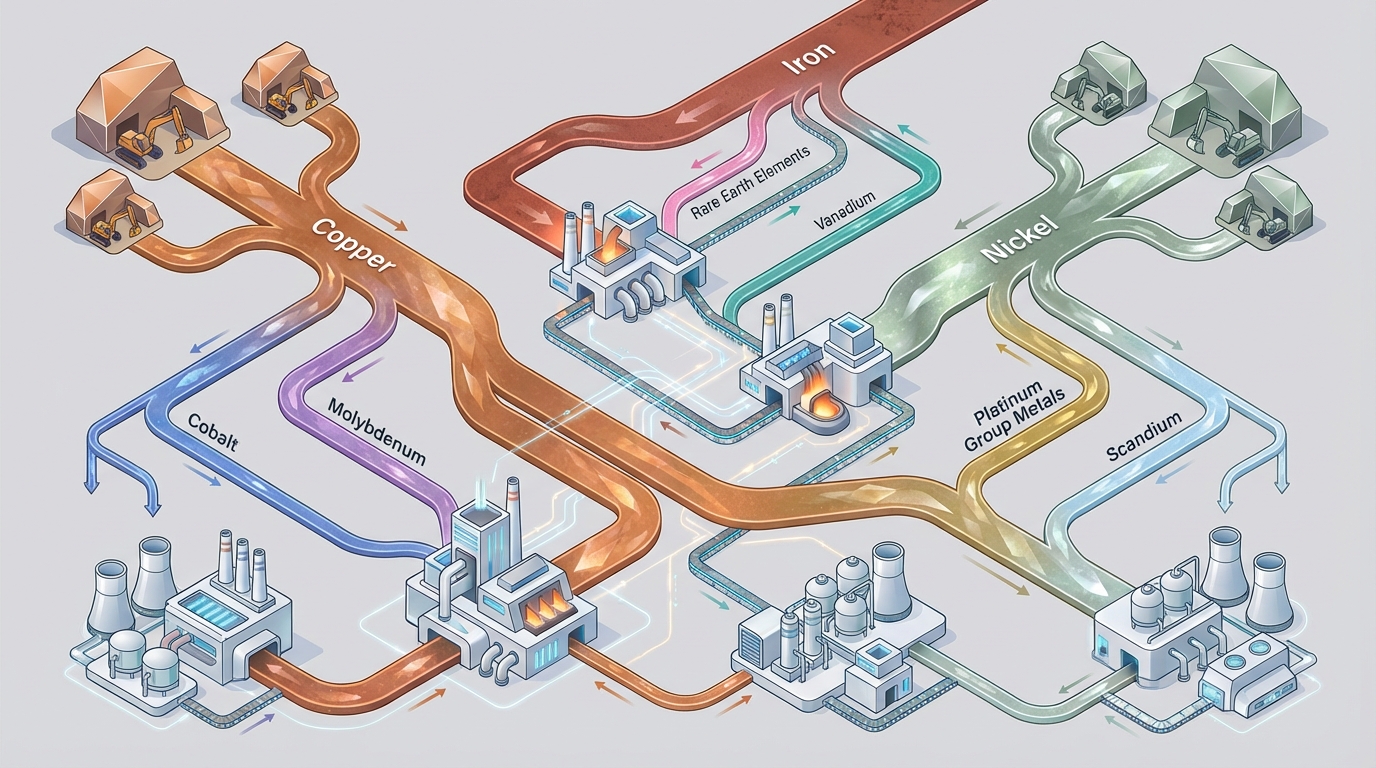
Evidence from market analyses has shown that as aluminum recycling ratios increase into the tens of percent on a global basis, the tonnage of bauxite processed via Bayer that carries gallium declines. At the same time, environmental and safety pressure around red mud storage has pushed refineries to minimize auxiliary processing on residues. The net effect is that even substantial price rises for gallium translate into only modest, delayed increases in recovery rates, because the limiting variable is the decision to build and operate additional extraction stages on a caustic, high-volume waste stream.
Germanium supply exhibits comparable rigidity. Zinc mine closures, ore-grade declines, and regional power-cost shocks can reduce smelter output in relatively short periods. Where germanium circuits are integrated, they idle when zinc plants idle. Where they are not integrated, adding them requires capex, permitting, and sometimes changes in residue classification from “waste” to “by-product,” which can trigger a different regulatory regime. This is why market data have repeatedly shown that germanium supply tracks zinc output far more closely than it tracks germanium prices.
A concise way to frame the structural issue is that gallium and germanium operate under a dual constraint: host‑metal throughput and processing configuration. Prices and demand for the minor metal sit downstream of these factors rather than setting them, which is the core of the “tyranny” terminology used in the literature.
China’s Dominance and the Emerging Supply-Security Map
China has, over several decades, built an integrated position across bauxite/alumina, aluminum smelting, zinc smelting, and the hydrometallurgical know‑how to recover minor elements such as gallium, germanium, indium, and cadmium from process streams and residues. Publicly available statistics from USGS and other agencies, as well as industry analysis, have repeatedly highlighted that China accounts for a very large share of refined gallium and a majority share of refined germanium.
This dominance is not solely the result of resource endowment. It reflects systematic investments in by-product recovery circuits at alumina refineries and zinc smelters, plus the co-location of high-purity refining plants. Facilities in Shandong and Liaoning, for example, have become reference points for high-purity gallium production from Bayer liquor and zinc residues. Chinese operators have also pioneered the use of advanced organic extractants and tailored ion-exchange resins to increase yields from low-concentration liquors, improving recovery rates without requiring drastic process redesign of the host refinery.
On the germanium side, Yunnan-based plants linked to large zinc smelters and coal operations account for a significant portion of world refined germanium oxide and metal. These complexes integrate roasting, leaching, residue handling, chlorination, and zone refining under one industrial umbrella, allowing efficient feedback between the base-metal and minor-metal circuits.
Recent Chinese export controls on gallium and germanium, implemented through licensing regimes, have introduced deliberate friction into this already concentrated system. Industry reports have documented steep declines in export volumes following the controls, with non-Chinese consumers drawing down inventories and accelerating qualifying projects in other jurisdictions. However, non-Chinese capacity remains fragmented and typically smaller in scale:
- North America: Efforts around zinc smelter complexes (such as projects at Teck’s Trail operations in Canada and proposed gallium/germanium recovery at Nyrstar’s Clarksville smelter in the United States) prioritize integrated residue recovery tied to domestic concentrate supply.
- Europe: Facilities like Portovesme in Italy have built germanium circuits, while emerging projects in Belgium and other EU member states aim to expand high-purity germanium oxide and blanks production, often tied to optics and space-applications value chains.
- Japan: Dowa’s Kosaka smelter and other facilities have focused heavily on scrap and electronic waste recycling for gallium, indium, and germanium, leveraging high collection rates and stringent traceability requirements to offset limited domestic primary feed.
- United States specialty refiners: Companies such as 5N Plus focus on upgrading germanium-containing scraps and imported intermediates to ultra-high-purity material for solar and semiconductor applications, reinforcing supply security for defense programs but constrained by feed availability.
Many of these facilities rely, directly or indirectly, on imported intermediates that still trace back to Chinese or Russian concentrates and residues. As a result, the geopolitical geometry of gallium and germanium is not simply about primary mining but about the topology of processing rights, export regimes, and the willingness of host states to underwrite residue-treatment infrastructure.
Technical Levers: Residue Circuits, Scrap, and Process Innovation
Within the constraints of companion-metal status, several technical levers can influence effective availability of gallium and germanium. These levers operate mainly at the level of process intensification, residue utilization, and recycling.
1. Red Mud, Jarosite, and Goethite Residue Utilization
Red mud from alumina refineries and jarosite/goethite residues from zinc smelters represent some of the most important latent resources for gallium and germanium. Both residue types are chemically challenging: highly alkaline in the case of red mud, strongly acidic and iron-rich in the case of jarosite/goethite. They also attract intense environmental scrutiny because of storage volumes, dam‑safety issues, and long-term stability.
Technical options for extracting minor metals from these residues include:
- Selective leaching with controlled pH and redox to dissolve gallium or germanium while minimizing co‑dissolution of iron and other impurities.
- Solvent extraction (SX) using specialized chelating agents (e.g., hydroxyoximes, β-diketones, or proprietary extractants like Kelex-type reagents) tailored for low-concentration gallium in strongly alkaline media.
- Ion exchange (IX) with resins engineered to selectively bind Ga(III) or Ge(IV) species, often used downstream of SX stages to polish solutions to semiconductor-grade specifications.
- Integrated residue valorization where extraction of gallium, germanium, and potentially rare earth elements is combined with production of construction materials or pigments to offset residue-management costs.
From an operational standpoint, the capex drivers are additional leach tanks, SX/IX equipment, and residue-repulping infrastructure, while opex is driven by reagent consumption, energy for heating and agitation, and waste neutralization. The key trade-off is between higher recovery rates and higher unit costs on a metal that does not control plant revenue. Where governments classify gallium and germanium as critical minerals, grant or loan programs targeted at residue circuits effectively become instruments of industrial resilience policy rather than classical project finance.
2. Coal Fly Ash and Power-Sector Integration
Germanium-enriched coal deposits and associated fly ash streams offer another lever, particularly in regions where power plants already handle ash as a regulated waste. Flowsheets here typically involve:
- Fly ash collection and classification, sometimes with pre-concentration of germanium-bearing fractions.
- Acidic leaching to dissolve germanium and certain other elements.
- SX/IX or precipitation to separate germanium from competing ions.
- Conversion to GeO2 and onward to metal.
However, coal-phase-out policies and shifts towards gas or renewables reduce the long-term predictability of fly ash feed. As seen in some European and North American pilot efforts, the timelines for monetizing germanium from ash often collide with policy timelines for decarbonizing power systems, which introduces strategy risk for operators considering such circuits as part of critical-materials planning.
3. Scrap and E-Waste Recycling
Recycling of gallium- and germanium-bearing products has emerged as an important buffer. Japanese and European operators, in particular, have developed complex hydromet circuits for LED scrap, GaAs wafer offcuts, epitaxial wafer scrap, CIGS solar cell scrap, IR optics, and fiber preform residues. These inputs exhibit much higher metal concentrations than ores or residues and can be treated in smaller, more flexible facilities.
Typical process sequences include mechanical separation, oxidative or acidic leaching, selective precipitation, SX/IX, and high-purity refining. Scrap-based supply is highly attractive in purity and carbon footprint terms, but fundamentally constrained by collection rates, product lifetimes, and scrap logistics. Industry analyses have often found that even highly efficient scrap systems can only cover a minority share of gallium or germanium demand, particularly in rapidly growing end markets where in-use stock is still building.
4. Process Intensification and Purity Upgrades
At the high-purity end of the chain, the technical hurdle is less about recovering more tonnes and more about achieving semiconductor- and optics-grade purities at acceptable cost and yield. Zone refining, vapor-phase epitaxy compatibility, and ultra-low impurity thresholds (often <10 ppm for certain contaminants) define the downstream specification space.
Germanium, in particular, often requires multiple refining passes and precise control of oxygen and metallic impurities before it can serve as a substrate for multijunction solar cells or as a material for high-end IR optics. The additional refining steps add a significant cost increment on top of the already constrained primary production, amplifying the impact of any disruption or feed-quality shift in upstream circuits.
Failure Modes, Scenarios, and Structural Trade-Offs
Understanding failure modes in gallium and germanium supply chains requires looking beyond the minor-metal circuits themselves to the behavior of host-aluminum and host‑zinc systems, as well as to regulatory and geopolitical layers.
Host Metal Disruptions and Maintenance Cycles
Short-term outages in gallium or germanium availability often originate from routine maintenance or unplanned downtime at alumina refineries or zinc smelters. A refinery that shuts down digestion or precipitation for several weeks halts any associated gallium side-circuit. Similarly, a zinc smelter undergoing relining, power-plant maintenance, or labor disputes delivers no jarosite or goethite residues for germanium extraction during that period.
Because these minor-metal circuits have very limited capacity to source alternative feed on short notice, the system behaves like a set of rigid nodes: each smelter-refinery complex is either delivering by-product-rich residues or not. In many cases, gallium or germanium recovery plants are physically co-located with the host refinery and cannot economically run on imported residues alone, further reducing flexibility.
Recycling Success vs Primary By-Product Availability
Another systemic failure mode is the unintended consequence of successful host-metal recycling or efficiency gains. As secondary aluminum share climbs, fewer tonnes of bauxite are digested through Bayer circuits, and gallium-bearing liquor volumes contract. If gallium side-circuits are not added to new or expanded alumina refineries to compensate, the aggregate gallium feed shrinks despite higher overall aluminum output.
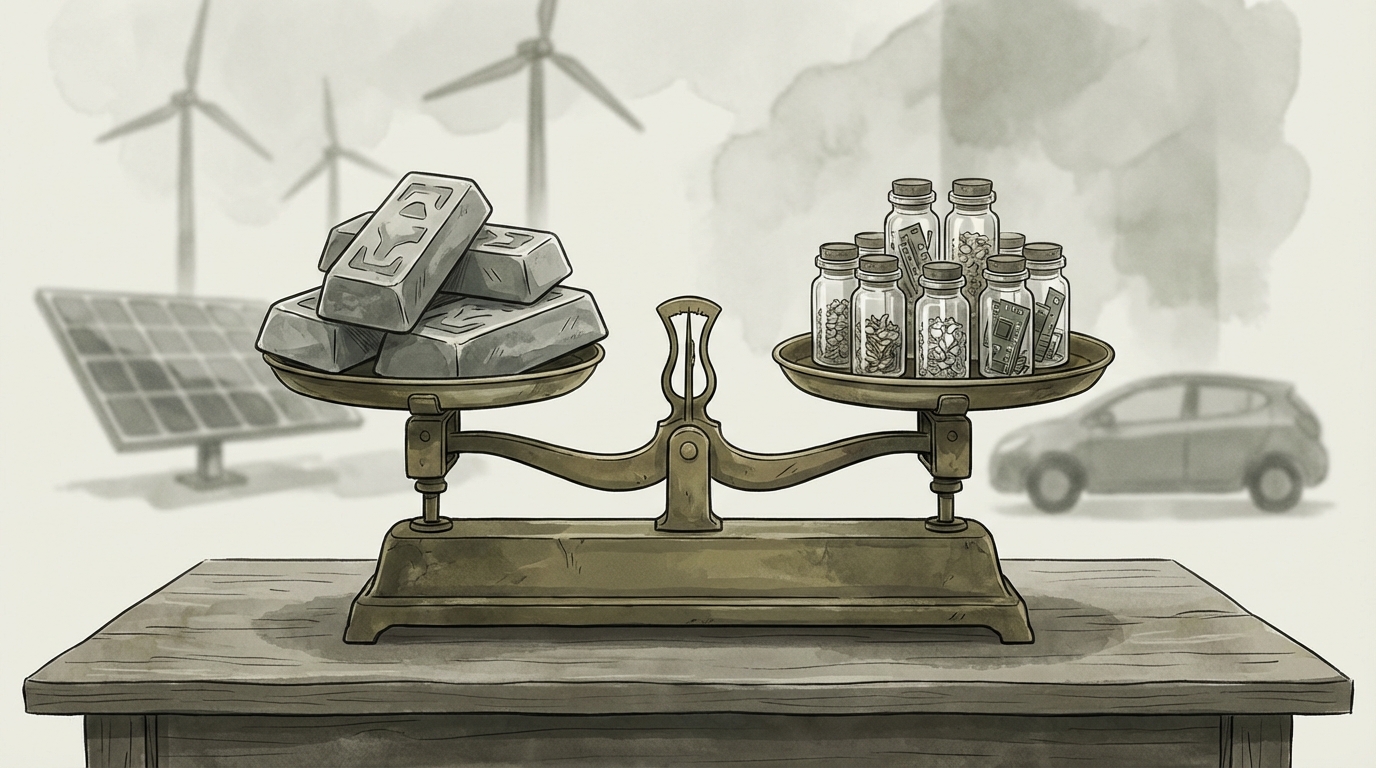
A similar though more nuanced effect can occur in zinc. Process improvements that decrease residue generation per tonne of zinc, or environmental policies that incentivize alternative residue treatment paths that do not include germanium recovery, effectively reduce the accessible germanium pool even if zinc volumes remain stable. In both cases, environmental and climate objectives pull in one direction, while critical-material security pulls in another. Without deliberate alignment, the by-product metals become collateral damage of otherwise rational policy choices.
Regulatory and Geopolitical Constraints
China’s licensing system for gallium and germanium exports illustrates how regulatory levers can amplify the underlying companion-metal rigidity. With a large share of global high-purity refining capacity located inside one jurisdiction, any additional friction on export flows-administrative delays, license denials, or informal guidance favoring domestic users-can rapidly translate into bottlenecks for defense, telecom, and optics supply chains elsewhere.
Sanctions regimes, such as those applied to certain Russian entities involved in germanium production, add another layer. Even where technical capacity exists, access to that capacity may be constrained by compliance considerations, insurance, shipping routes, or banking channels. Non-Chinese, non-Russian facilities in North America, Europe, and Japan thus take on outsized importance for industrial resilience, despite often operating at smaller scale and with more expensive feedstock.
The interplay between environmental regulation and by-product recovery is equally significant. Stricter red-mud dam standards, tailings governance for jarosite and goethite, and carbon-border adjustment mechanisms all influence whether and where residue-based gallium and germanium circuits are viable. In some cases, compliance frameworks explicitly recognize critical-minerals recovery as a positive factor; in others, they treat any additional chemical processing as a further liability, which can discourage projects even where technical feasibility is high.
Historical Analogues: Lessons from Indium, PGMs, and Cobalt
The challenges observed in gallium and germanium are not unique. Other minor metals have already demonstrated how companion status can constrain supply in ways that simple price-volume models fail to capture.
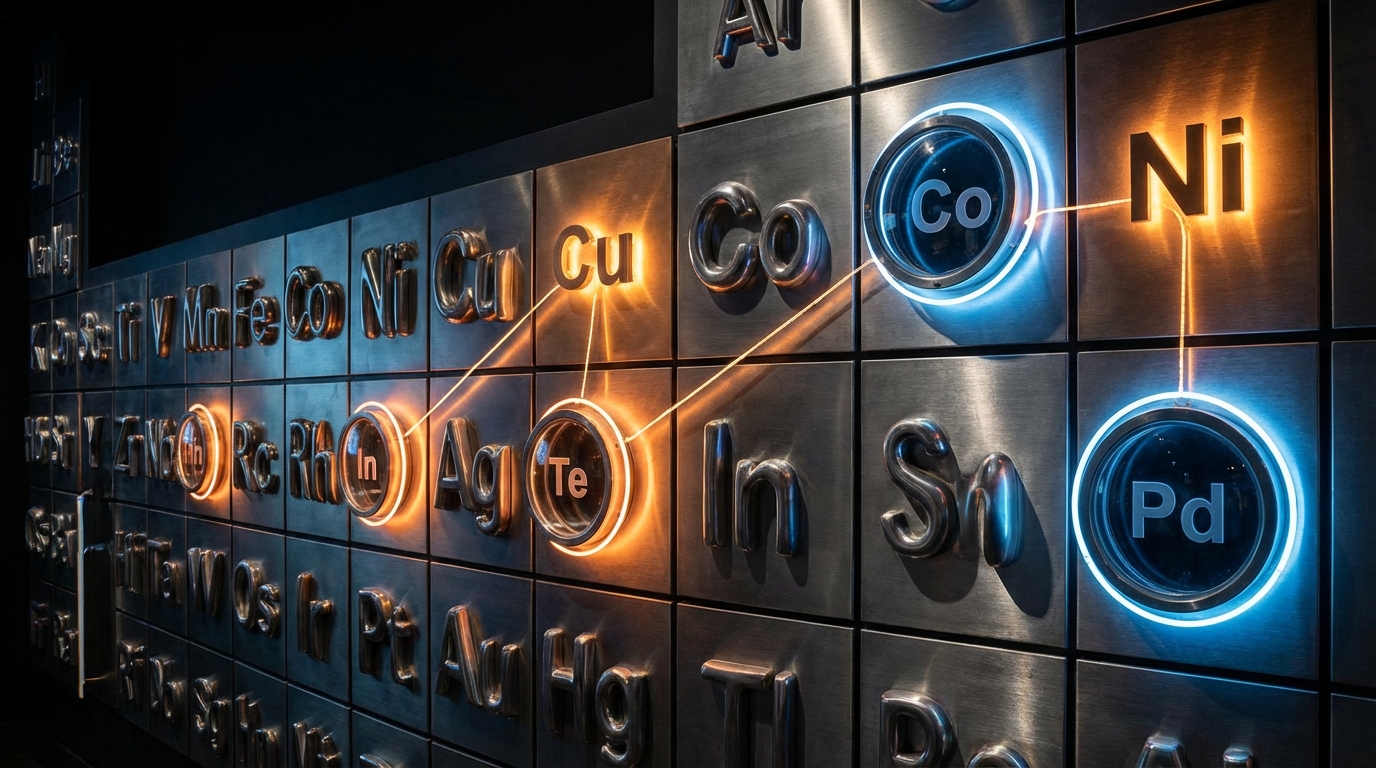
Indium is a well-known by-product of zinc processing, much like germanium. During LCD boom periods, indium demand surged far faster than zinc output, leading to tight markets and accelerated efforts to recover indium from smelter residues and ITO (indium tin oxide) sputtering scrap. However, the ceiling on primary indium production remained fundamentally tied to zinc smelting capacity and the willingness of smelters to install and operate recovery circuits. Only when recycling and process improvements matured did the system stabilize.
Platinum group metals (PGMs) highlight a related phenomenon in the context of nickel and copper mining. In several regions, PGMs are primarily recovered as by-products of nickel or copper operations. When nickel demand weakens or ore grades change, PGM output can decline even in periods of robust automotive or industrial demand for catalysts, with supply adjustments lagging years behind price signals due to the long lead times for mine expansions or new shafts.
Cobalt, while not purely a by-product, exhibits partial companion-metal behavior in copper and nickel mines in Central Africa and elsewhere. Changes in copper project pipelines or geopolitical conditions in a few key jurisdictions have repeatedly affected cobalt availability for battery manufacturers, demonstrating the vulnerability that arises when a critical material is largely produced as a side-effect of another commodity’s economics.
These analogues underscore a central insight: once a metal is structurally positioned as a by-product or companion, moving it to a demand-driven supply regime is extremely difficult. It typically requires either the discovery of economically viable primary deposits, a fundamental shift in process technology that enables more flexible extraction from residues or wastes, or dramatic policy interventions that reshape host-metal sector behavior. Gallium and germanium, with their occurrence at tens of ppm in host materials and reliance on complex hydrometallurgical circuits, sit firmly in this category.
Operational Implications and Concluding Synthesis
The gallium and germanium story, viewed through the lens of by-product dependency and the tyranny of companion metals, is ultimately about system design rather than single-node optimization. Advanced extractants, better ion-exchange resins, and improved refining practices do matter, but they operate within a framework constrained by host-metal throughput, residue classifications, recycling dynamics, and increasingly assertive geopolitics.
For operators, policymakers, and downstream technology manufacturers, three structural realities stand out. First, primary availability of gallium and germanium is set by decisions in the aluminum and zinc sectors that are often made with no direct reference to minor metals, yet these decisions echo through defense, semiconductor, and optics supply chains. Second, environmental and climate policies that accelerate recycling or tighten residue standards can unintentionally compress the by-product feedstock base unless they are explicitly coupled with residue-processing initiatives. Third, the geographic concentration of sophisticated residue and high-purity refining circuits in a small number of jurisdictions, particularly China, multiplies the strategic impact of any change in export, energy, or industrial policy.
Materials Dispatch’s assessment is that gallium and germanium have moved from being obscure side streams to becoming litmus tests for how effectively industrial systems can integrate critical-materials thinking into bulk-metal, power, and environmental decision-making. The future trajectory will be determined less by single headline projects and more by cumulative choices on Bayer liquor side-streams, jarosite management, fly ash policy, and scrap-collection infrastructure. The firm is actively monitoring weak signals across export-control regimes, residue-processing technologies, aluminum and zinc recycling trends, and defense-sector material specifications that will indicate whether this tyranny of companion metals is being mitigated or deepened.
Note on Materials Dispatch methodology Materials Dispatch integrates continuous monitoring of regulatory texts and trade measures, including Chinese export-control communications, with systematic review of geological and process data from entities such as the USGS and peer-reviewed hydrometallurgical studies. This is cross‑referenced with end-use technical specifications in semiconductors, optics, and defense systems to identify where by-product constraints intersect with performance-critical materials requirements.


