Uncategorized
India’s Rare Earth Ambition: Massive Reserves, Decades Behind


India sits on some of the world’s most substantial rare earth reserves and yet contributes only a sliver of global production. For Materials Dispatch, this gap is not an academic curiosity; it is a concrete supply-chain risk. Over the past decade, every serious rare earth disruption-Chinese export curbs, Myanmar instability, opaque licensing changes-has translated into hard procurement problems for downstream users in magnets, motors, catalysts, and defense systems. Internal sourcing cycles have repeatedly run into the same roadblock: India appears on paper as a “sleeping giant” in rare earth geology, but on the ground it behaves like a marginal supplier.
The 2025-2026 policy pivot in India, centered on monazite-based value chains and new manufacturing schemes, is the first credible attempt to close that gap. It deserves close, critical scrutiny because it has the potential to change sourcing options for magnets and refined oxides, while also introducing new regulatory and operational complexities around nuclear-linked minerals, coastal mining, and state-backed monopolies.
- Change: India is moving from raw monazite extraction towards an integrated rare earth value chain, anchored by a new permanent magnet manufacturing scheme and planned rare earth corridors.
- Scope: The focus is on monazite-based reserves, downstream processing, and rare earth permanent magnets, under a regime still dominated by state-owned IREL and atomic energy regulators.
- What is covered: Geological endowment, institutional/regulatory framework, and headline policy measures (scheme outlays, capacity targets, corridor concepts).
- What is not covered: Precise project-by-project economics, detailed pricing outcomes, and definitive timelines for all corridor elements, which remain either unpublished or fluid.
- Operational angle: To the extent that these measures are executed, they could partially diversify supply away from China’s refining dominance, but only after navigating thorium regulations, community resistance to beach mining, and the constraints of a de facto monopoly.
FACTS: Resource Base, Institutional Setting, and New Policies
India’s rare earth reserves and monazite dominance
According to public geological reporting and international comparisons, India holds the world’s third-largest rare earth oxide (REO) reserves at around 6.9 million tonnes. Annual rare earth production, however, has been estimated at only about 2,900 tonnes in 2024, which corresponds to less than 1% of global output. The contrast between reserves and production is the core structural fact behind the “sleeping giant” label widely applied to India in this sector.
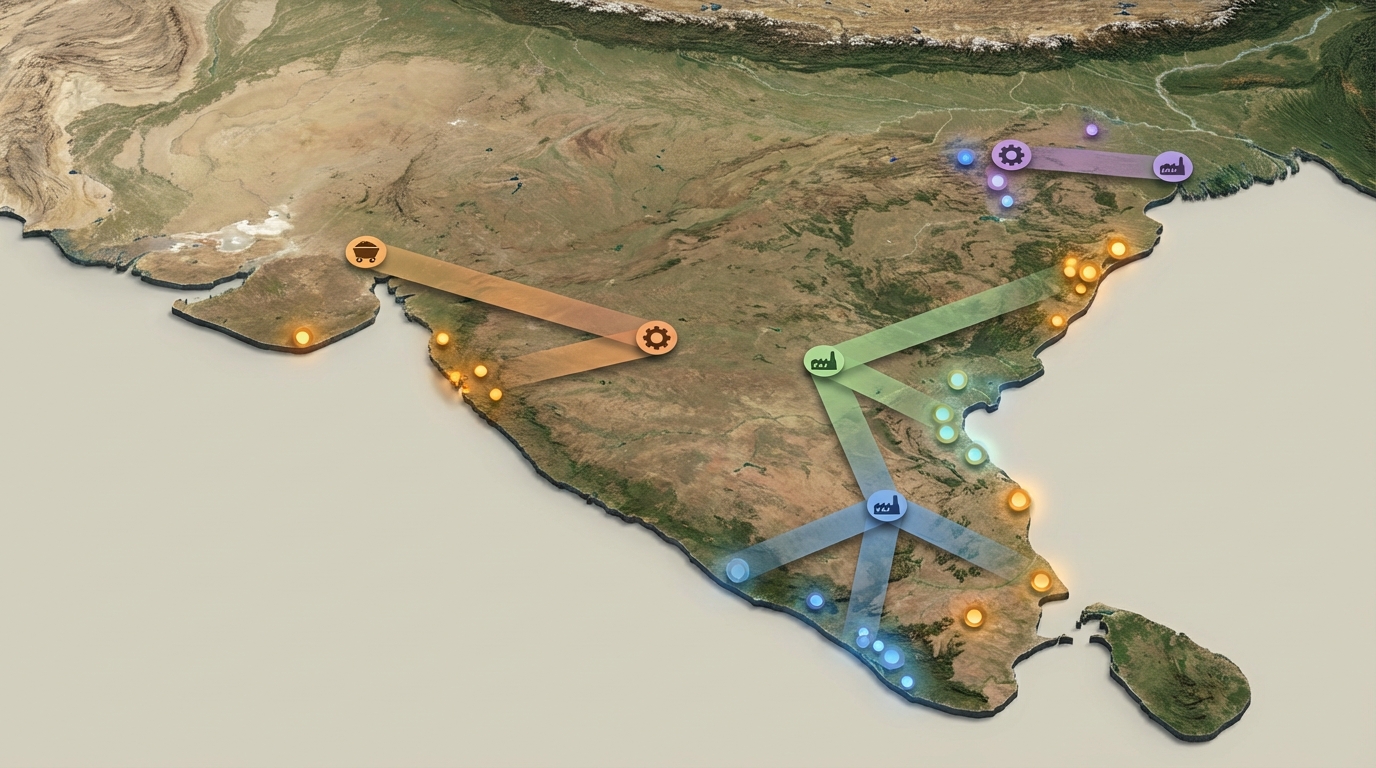
Unlike many other producing regions where bastnäsite or hard-rock deposits dominate, India’s rare earth endowment is heavily concentrated in monazite-bearing beach and inland placer sands along the coasts of states such as Andhra Pradesh, Kerala, Odisha, and Tamil Nadu, with additional occurrences in Gujarat, Maharashtra, Jharkhand, and West Bengal. Monazite typically contains both light rare earth elements and thorium, which brings the sector under India’s atomic energy and radiation safety framework.
Exploration and resource estimation for these deposits fall primarily under the Atomic Minerals Directorate for Exploration and Research (AMD) and the Geological Survey of India (GSI), which have progressively upgraded estimates for total monazite-bearing sands and associated REO content. Public figures cited in recent years point to monazite reserves in the tens of millions of tonnes, with rare earth oxide content measured in several million tonnes, consistent with India’s ranking as third globally by reserves.
Institutional and regulatory structure: IREL, DAE, and AERB
Monazite and several related minerals are classified as atomic minerals in India. This classification places their mining, processing, and handling under the purview of the Department of Atomic Energy (DAE) and associated regulators, most notably the Atomic Energy Regulatory Board (AERB).
The central industrial actor is Indian Rare Earths Limited (IREL), a DAE-owned entity that historically has held an effective monopoly over monazite processing and rare earth extraction. IREL operates facilities in coastal locations such as Odisha and Kerala, and has been involved in joint ventures, including with Japan’s Toyota Tsusho at Visakhapatnam, to process certain rare earth streams. Despite this footprint, total rare earth production remains modest relative to India’s geological potential.
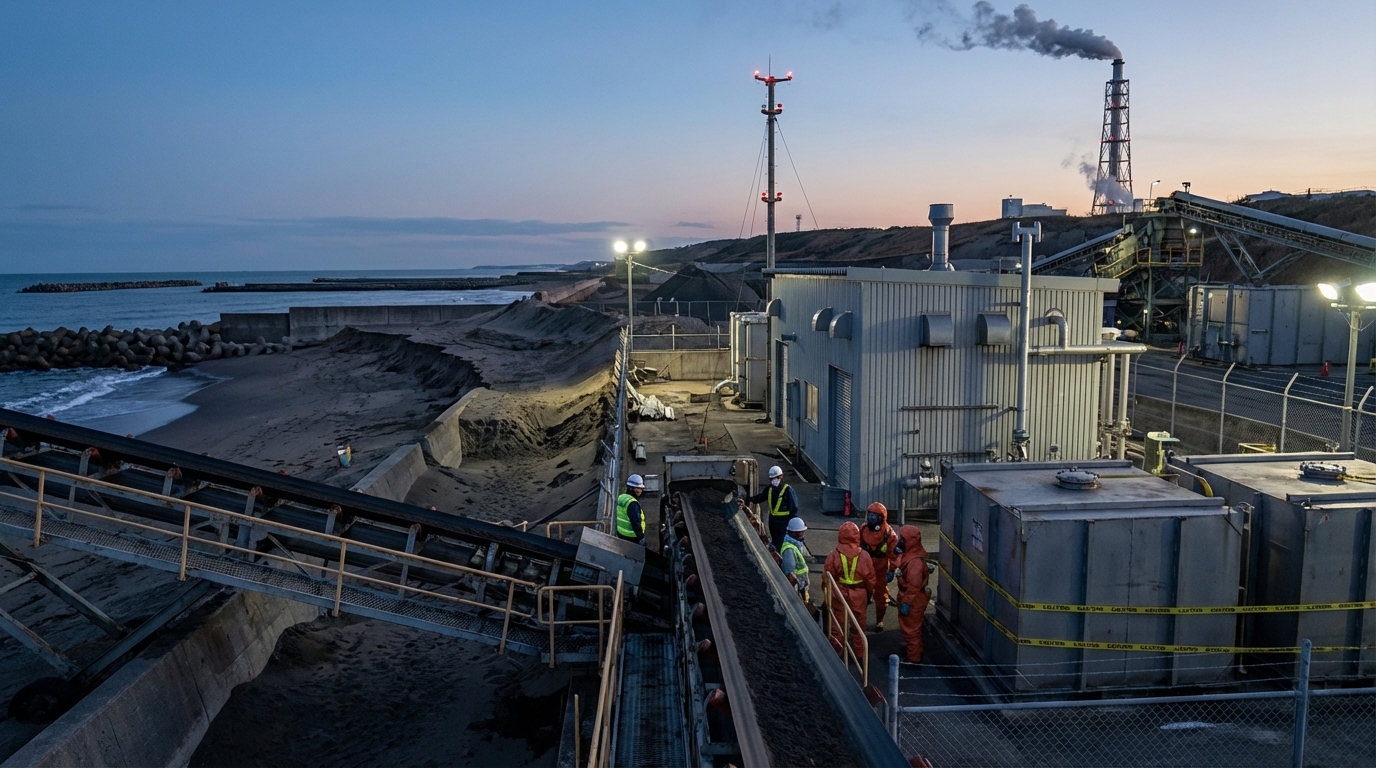
Regulatory oversight by AERB focuses on radiation protection, safe handling of thorium-bearing materials, and management of radioactive tailings. Environmental approvals, coastal zone regulations, and community consent processes add further layers of scrutiny, especially for beach sand mining projects that have attracted local opposition and political attention in several states.
Strategic framing: Atmanirbhar Bharat and Net Zero 2070
Rare earths have been explicitly linked in Indian policy discourse to the twin agendas of Atmanirbhar Bharat (self-reliant India) and the country’s declared Net Zero 2070 target. The logic is straightforward: rare earth permanent magnets and related materials are embedded in electric vehicles, wind turbines, advanced electronics, and defense platforms that are central to both decarbonization and strategic autonomy.
In parallel, global developments have heightened the salience of rare earth security. China is estimated to control around 90% of global rare earth refining capacity, even as demand from EVs, renewables, and electronics continues to rise. Export controls, licensing changes, and geopolitical tensions have periodically disrupted flows, while policy frameworks such as the US Inflation Reduction Act and the EU Critical Raw Materials Act have explicitly sought diversification away from single-country dominance.
Against this backdrop, India’s combination of substantial reserves and minimal production has increasingly been treated in official and industry narratives as a glaring vulnerability and a missed strategic lever.
REPM manufacturing scheme: outlay and capacity targets
In late 2025, the Indian government approved a dedicated Scheme to Promote Manufacturing of Sintered Rare Earth Permanent Magnets (REPM), under the Ministry of Heavy Industries. Public communications describe an outlay of approximately ₹7,280 crore and a target to support up to 6,000 tonnes per year of integrated permanent magnet manufacturing capacity.
Key structural features of the scheme, as described in government and media summaries, include:
- A focus on integrated projects spanning from rare earth oxide input through to finished sintered magnets.
- Selection of up to five beneficiary entities, with individual caps intended to avoid concentration in a single player.
- Incentive support linked to establishing domestic capability in magnet manufacturing, with an emphasis on applications in EVs, renewable energy, and defense.
- Compatibility with India’s wider industrial policy framework, including localization, technology transfer, and employment objectives.
Detailed operational guidelines, including exact eligibility criteria, incentive structures, and phasing, have been partially outlined but remain subject to implementation rules and subsequent clarifications.
Emerging plan for rare earth corridors
Budget and policy announcements in the 2026 timeframe have also trailed the concept of dedicated rare earth corridors, with geographic focus on coastal states where monazite-bearing sands are concentrated. These corridors are positioned as integrated ecosystems that would link:
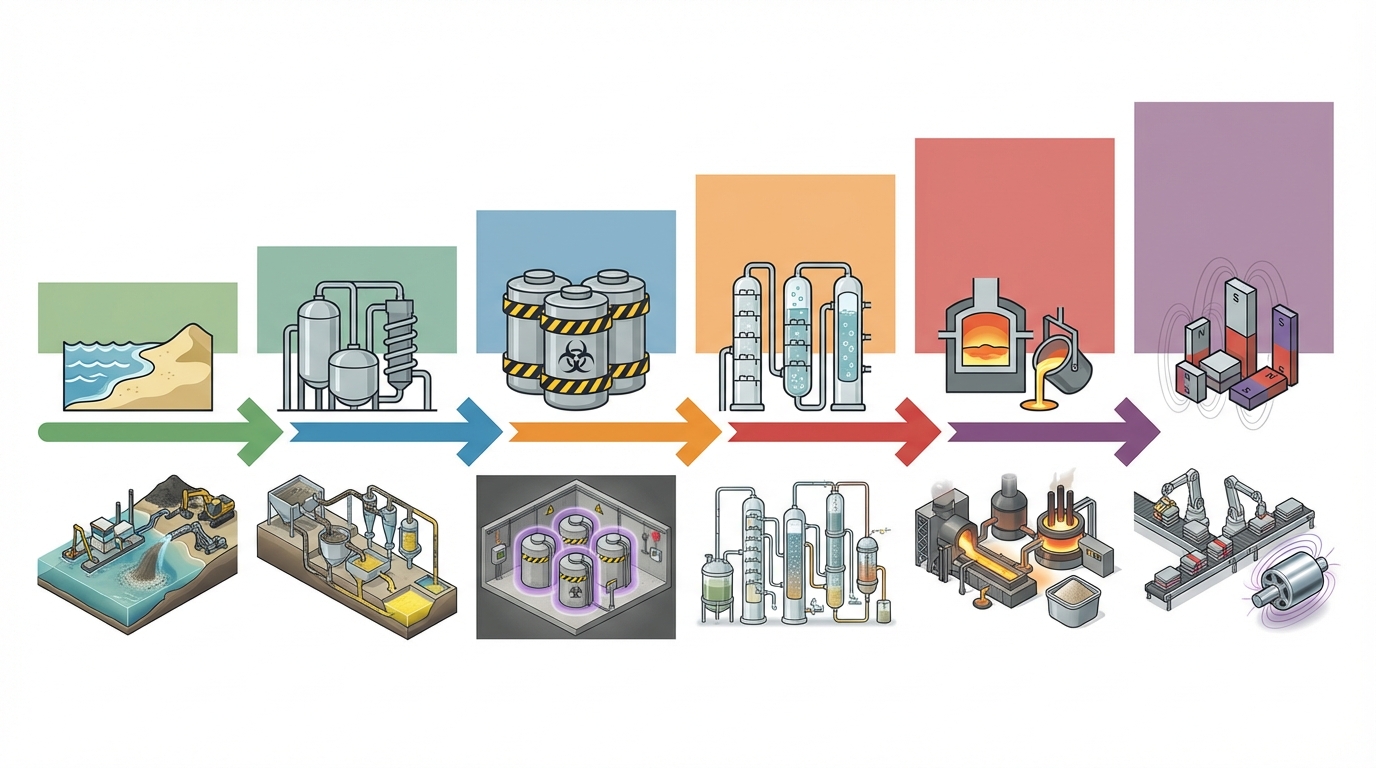
- Mining and beneficiation of monazite and associated heavy minerals.
- Intermediate processing to mixed rare earth compounds and oxides.
- Separation and refining steps for individual rare earth elements.
- Downstream applications such as permanent magnets and other advanced materials.
The corridor model is intended to combine infrastructure development, streamlined clearances, and co-location of suppliers and users. Operational details-such as specific sites, timelines for commissioning, and the balance between public and private participation—have been signaled but not comprehensively published in a single binding document.
INTERPRETATION: From Geological Promise to Operational Reality
Why India lags: structure, regulation, and incentives
From a supply-chain practitioner’s standpoint, India’s rare earth lag is not mysterious. It is the predictable outcome of an institutional design that treats monazite primarily as a nuclear-adjacent material rather than as the backbone of a competitive industrial value chain.
To the extent that IREL retains a de facto monopoly and operates under nuclear-sector governance, the incentive structure tends to prioritize compliance, control, and thorium stewardship over agility, scale, and downstream customer engagement. That conservatism has clear safety and non-proliferation benefits, but in practice it has translated into:
- Limited throughput relative to reserves, with several deposits remaining underexploited or idle.
- Slow movement into high-purity separation and advanced magnet manufacturing.
- Reliance on exports of intermediate materials or concentrates, rather than capturing the full value chain domestically.
On top of that, the beach sand mining context is politically sensitive. Environmental concerns, coastal erosion, and community resistance have led to periodic suspensions, investigations, and policy reversals in multiple states. For downstream users that Materials Dispatch has engaged with, that pattern has made Indian-origin rare earth feedstocks look administratively fragile compared with more conventional hard-rock sources elsewhere.
Does the REPM scheme change the game?
The REPM manufacturing scheme is the first serious attempt to push India beyond raw material extraction into magnet-level industrial capabilities. The size of the outlay and the explicit 6,000 tonnes per year capacity target indicate that the government is no longer content with a marginal role in the magnet supply chain.
If the scheme is implemented as described, several implications follow:
- For domestic OEMs in automotive, renewables, and defense, there is a pathway—over time—to source at least part of their rare earth permanent magnet needs from within India, reducing exposure to external refining and magnet supply disruptions.
- For global supply chains, India becomes a potential secondary pole, especially for applications seeking to avoid magnets produced in China while still managing cost and logistics constraints.
- For IREL and other state-linked entities, there is pressure to evolve from a primarily mining-and-basic-processing posture to more customer-facing, performance-sensitive business models.
The critical caveat is that successful magnet manufacturing depends not only on capital and policy support but also on consistent access to separated rare earth oxides, reliable process know-how, and sustained quality control. India’s track record in high-purity separation at scale is limited. Without robust technology partnerships and process learning, the risk is a set of partially utilized plants that remain dependent on imported oxides, which would blunt the scheme’s geopolitical and supply-security ambitions.
Rare earth corridors: integration or new bottleneck?
The proposed rare earth corridors are conceptually attractive. Co-locating mining, separation, and manufacturing has repeatedly proven its value in other jurisdictions: reduced logistics friction, easier coordination between stages, and a clearer regulatory perimeter. In India’s case, the corridor model could also provide a vehicle to reconcile atomic energy oversight with industrial policy goals, through dedicated project structures and standardized approval pathways.
However, several execution risks are visible from past experience with industrial corridors and coastal projects:
- Land and community issues: Beach and coastal deposits intersect with dense populations and environmentally sensitive zones. If corridor planning treats these as purely technical siting decisions, resistance and litigation could delay or derail projects.
- Regulatory layering: Even with corridor-level facilitation, projects will need to navigate atomic energy, radiation safety, environmental, coastal zone, and state-level industrial approvals. Without genuine streamlining, corridors can simply aggregate bottlenecks.
- Governance of joint ventures: To attract global magnet and materials specialists, corridor projects will likely rely on JVs. The balance of control between state entities like IREL and private or foreign partners will shape both performance and risk perception.
If these issues are handled pragmatically, corridors could accelerate India’s transition from reserves holder to meaningful player in refining and magnets. If not, they risk becoming another layer of planning rhetoric that leaves India fundamentally dependent on imported magnets and separated oxides.
Geopolitics and friendshoring: India’s window of relevance
Global rare earth supply chains are increasingly shaped by friendshoring logics rather than pure cost optimization. For defense-linked and high-performance applications in particular, the combination of China’s refining dominance and rising geopolitical tension has pushed policymakers and OEMs to search for alternative anchor countries.
India’s rare earth vector intersects with this in three ways:
- Quad and allied frameworks: Partnerships with Japan, the US, and Australia have already produced joint ventures and technical cooperation around critical minerals. Successful corridors and REPM plants could be natural candidates for expansion of these arrangements.
- Compliance with Western industrial policies: To the extent that India demonstrates transparent, traceable, and environmentally compliant rare earth supply, its materials may fit within rules that distinguish “trusted” supply from others, particularly in EV and defense supply chains.
- Signaling effect: A visible ramp-up in India’s rare earth production and magnet output, even from a low base, changes the bargaining landscape. It provides a counterweight in discussions about supply security, even if absolute volumes remain modest relative to China.
The flip side is that unrealized promises carry their own cost. India has already spent years being cited in strategy decks as a potential alternative that rarely materializes in procurement contracts. If the current wave of schemes and corridors underdelivers, future claims about Indian rare earth capacity will likely be discounted more aggressively by global offtakers and policymakers.
Downstream sectors: EVs, wind, and defense under pressure
From the vantage point of OEMs and tier-1 suppliers in India and allied markets, the operational question is simple: can Indian rare earth projects become reliable, specification-compliant, and politically acceptable sources of magnets and oxides within realistic planning horizons?
EV manufacturers, wind turbine producers, and defense contractors have already had to cope with supply shocks and policy-driven sourcing constraints. In internal reviews that Materials Dispatch has been involved with, many such entities treat India more as a future option than a present pillar in their rare earth sourcing strategies. The REPM scheme and corridors, if executed with credible partners and stable regulation, could over time shift that perception.
However, until concrete plants are built, ramped, and proven over several years of consistent output, India’s role will remain largely prospective. The harsh lesson from past disruptions is that paper reserves and policy announcements do not move the needle in procurement risk models until they translate into dependable shipments that meet tight technical and compliance specifications.
WHAT TO WATCH: Signals That Will Confirm or Contradict the Pivot
- Final REPM scheme guidelines and award outcomes: Publication of detailed rules, selection of beneficiaries, and clarity on how integrated the awarded projects really are (from ores/oxides to magnets).
- Concrete announcements on rare earth corridors: Identification of specific sites, SPV structures, and timelines, plus evidence of coordinated infrastructure and regulatory facilitation rather than purely declarative zoning.
- Regulatory evolution around monazite and thorium: Any amendments, clarifications, or new guidelines from DAE and AERB that affect how monazite mining, processing, and tailings are managed in an industrial, not purely nuclear, frame.
- Role and behavior of IREL: Whether IREL remains the sole operational gatekeeper, moves into more partnership-based models, or sees partial opening of the value chain to other qualified entities under regulatory oversight.
- Joint ventures and technology partnerships: New or expanded collaborations with foreign magnet producers, separation technology suppliers, or end-use OEMs that bring in process expertise and credible offtake anchors.
- Environmental and community responses: Local resistance, litigation, or, conversely, examples of negotiated agreements around coastal and inland projects that signal a stable social license to operate.
- Export and import statistics: Shifts in India’s rare earth oxide and magnet trade flows over the next several years, indicating whether domestic capacity is genuinely displacing imports or is primarily re-exporting intermediate materials.
Conclusion
India’s rare earth sector is finally moving from rhetorical asset to policy target. The combination of large monazite-based reserves, a state-backed incumbent in IREL, and new schemes for magnet manufacturing and corridors creates a framework that could, if executed, alter the geography of rare earth refining and magnet supply over the next decade. At the same time, the very features that have held India back—atomic mineral regulation, environmental sensitivity of beach sands, and state-heavy governance—have not disappeared.
Material progress will be measured not in press releases but in commissioned plants, consistent throughput, and verifiable compliance with both radiation safety and environmental standards. For now, India remains simultaneously a major geological holder of rare earths and a minor industrial player. Materials Dispatch will continue active monitoring of regulatory and industrial weak signals that will determine whether India’s rare earth ambition resolves into durable supply-chain reality.
Note on Materials Dispatch methodology Materials Dispatch integrates continuous monitoring of official releases from entities such as the Ministry of Heavy Industries, DAE, AERB, and geological agencies with structured tracking of market behavior in relevant end-use sectors. This is combined with close reading of technical specifications in magnets, motors, alloys, and catalysts to assess whether emerging projects align with real-world performance and compliance requirements across strategic and critical materials.


