Sentiment Analysis
How Much Rare Earth Goes Into a Fighter Jet and Why the West Has a Problem


How Much Rare Earth Goes Into a Fighter Jet and Why the West Has a Problem
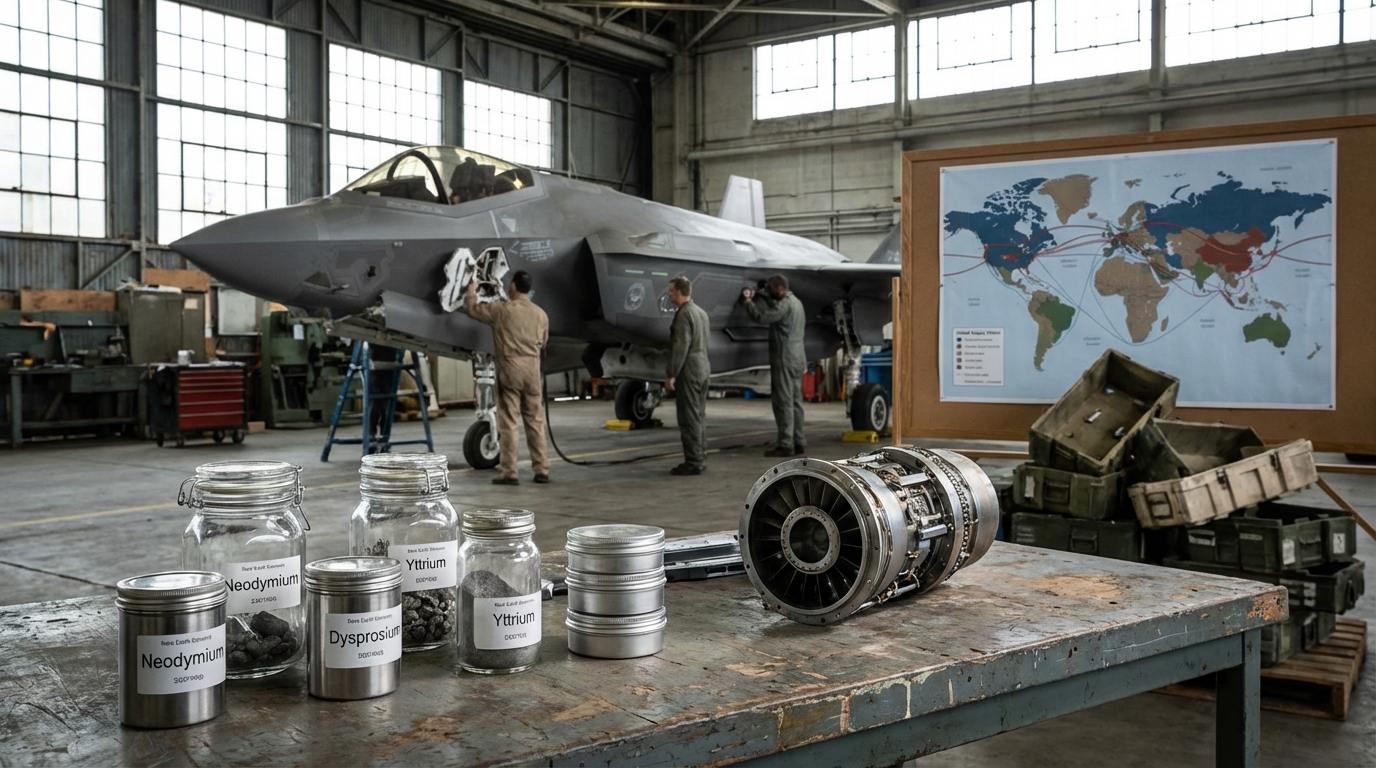
Executive insight: The question “how many rare earth elements sit inside a fighter jet” sounds academic until production lines slow down because a single samarium-cobalt magnet fails a security review. Rare earth content in a modern fighter is measured in hundreds of kilograms, and almost every kilogram is embedded in a function that cannot simply be designed out: thrust vectoring, flight control actuators, radar, electronic warfare, and power generation. That is where dependency becomes structural.
The core operational question is straightforward: how exposed are Western combat air fleets, in practice, to disruptions in rare earth mining, separation, and magnet fabrication? Once the mass of neodymium, praseodymium, samarium, dysprosium, and terbium inside each airframe is quantified, it becomes clear that this is no longer a niche materials issue; it is an availability and readiness constraint for front‑line platforms.
Materials Dispatch’s view is that rare earth exposure in airpower is fundamentally a magnet problem. Catalysts, phosphors, and polishing powders matter, but they do not ground fleets. Permanent magnets in actuators and sensors can. That is why NdFeB and SmCo magnet chains sit at the center of this analysis of rare earth elements fighter jet dependency.
What Sits Inside a Fighter: F‑35 as a Reference Case
Publicly cited defense supply chain research has converged on a headline number: approximately 418 kg of rare earth elements per F‑35 airframe.1 This figure aggregates oxides and metals across magnets, sensors, and specialist alloys. The distribution is not uniform, but a simplified breakdown illustrates the structure of dependency:
- NdFeB permanent magnets (neodymium-iron-boron), with neodymium and praseodymium as principal rare earth inputs, serving motors, generators, and many actuators.
- SmCo magnets (samarium–cobalt), where samarium and heavy rare earth dopants provide high coercivity and temperature stability for engine‑adjacent and high‑radiation environments.
- Heavy rare earth dopants such as dysprosium and terbium to increase magnet coercivity in NdFeB magnets, particularly in high‑temperature zones.
- Specialty alloys and phosphors using gadolinium, yttrium, and others in sensing, thermal management, and certain laser or display components.
The AN/APG‑81 AESA radar, the Distributed Aperture System, the Electro‑Optical Targeting System, and the fly‑by‑wire control architecture all make intensive use of rare earth magnets and materials. SmCo magnets appear in actuators and engine subsystems that operate at temperatures where NdFeB magnets would demagnetize or age unacceptably. NdFeB magnets, in turn, dominate where high power density and compact form factor are paramount, such as compact electric motors and generators in the electrical power system.
Visualizations of U.S. defense rare earth use compiled by Visual Capitalist from U.S. government data highlight the same pattern across platforms: fighter jets, precision munitions, and missile defense systems are all magnet‑intensive, with the F‑35 singled out as one of the most REE‑intensive systems in the U.S. inventory.2 In other words, rare earth exposure is baked into the airframe’s architecture rather than concentrated in any single bolt‑on subsystem.
Beyond the F‑35: Eurofighter, Rafale, and Naval Platforms
There is far less public, quantified data for Eurofighter Typhoon and Dassault Rafale, but architecture analysis points to similar qualitative dependency levels. Both aircraft rely on:
- AESA radars (CAPTOR‑E for Eurofighter, RBE2‑AA for Rafale) that use rare earths in transmit/receive modules and associated power electronics.
- Electro‑hydrostatic and electro‑mechanical actuators for primary and secondary flight control surfaces, driven by permanent magnet motors.
- High‑reliability generators and starter–generators on the engine providing electrical power under harsh thermal conditions.
- Advanced electronic warfare suites and optronics systems that again lean on REE‑based magnets, phosphors, and specialty ceramics.
Industry commentary frequently extrapolates that Eurofighter and Rafale incorporate rare earth tonnages in roughly the same range as the F‑35 – in the hundreds of kilograms per airframe – once magnets, sensors, and materials are counted.3,5 The exact mix between light and heavy rare earths will differ (for example, the share of HREE dopants in radar vs. actuator magnets), but from a supply chain standpoint, the broad exposure looks similar.
The dependency is even more visible in naval combatants equipped with high‑power electric drives and complex sensor suites. Estimates disseminated through Visual Capitalist report that an Arleigh Burke‑class destroyer may embed around 2,600 kg of rare earths, while a Virginia‑class submarine may rely on approximately 4,600 kg for propulsion, sonar, and weapons systems.2 When those numbers are benchmarked against fighter platforms, a structural conclusion emerges: naval assets concentrate more total rare earth mass per hull, but fighter production cadence makes narrow bottlenecks in magnet supply equally consequential.
Why Magnets Define Defense Rare Earth Exposure
Rare earths appear across industrial value chains, but in defense, permanent magnets are the load‑bearing application. For most non‑magnet uses – catalysts, polishing powders, glass additives – process engineers can often reformulate with non‑REE substitutes at some performance penalty. That substitution logic breaks down for high‑performance permanent magnets in critical systems.
NdFeB magnets deliver the highest energy product of commercially available magnets, enabling compact, high‑torque motors and generators. In fighters and naval vessels, these magnets power:
- Flight control actuators and back‑up actuation paths.
- Starter–generators and auxiliary power units.
- Fuel pumps, hydraulic pumps, and other rotating machinery where efficiency and reliability are paramount.
- Certain gimbal and pointing mechanisms for sensors.
SmCo magnets sacrifice some maximum energy product compared to NdFeB but maintain magnetization at significantly higher temperatures, often cited in the 250–350°C operating range for advanced grades, along with superior radiation resistance. This makes SmCo the material of choice for:
- Engine‑proximate actuators and control devices.
- High‑temperature sensors and alternators.
- Certain missile guidance and control applications where thermal cycling is extreme.
The coercivity of both NdFeB and SmCo magnets in military applications is often enhanced by adding dysprosium and terbium, especially for NdFeB. Those heavy rare earths are geologically rarer and even more geographically concentrated than base light rare earths such as neodymium and praseodymium. That is why, from an operational risk standpoint, “rare earth magnets defense” is not just about volume; it is about specific dopants that enable the coercivity and stability demanded by mil‑spec actuators and sensors.
One structural finding stands out: in a fifth‑generation fighter, the rare earth bill of materials is less about the visible airframe and more about an invisible magnetic skeleton that holds the aircraft’s electronic nervous system together. That skeleton connects directly to a small number of specialized magnet plants, many still located in or dependent on processing steps in China.
China’s Dominance in the Defense Rare Earth Supply Chain
USGS and trade data consolidated by multiple research groups indicate that China accounts for a large share of global rare earth mining and an even higher share of separation and magnet production. Visual Capitalist’s widely circulated breakdown, drawing on U.S. government statistics, shows China as the dominant source of U.S. rare earth imports over recent years, frequently representing the majority of total import volumes.2
The concentration is particularly acute in NdFeB magnet manufacturing. Mining and primary concentration have begun to diversify – with Mountain Pass in the United States and Mount Weld in Australia prominent – but separation, metal making, and especially magnet alloying and sintering remain clustered in East Asia, with China as the central node. For samarium, dysprosium, and terbium, non‑Chinese separation capacity is materially smaller than for NdPr oxides, amplifying the exposure for SmCo and high‑coercivity NdFeB grades.
Policy actions have translated this structural concentration into direct supply risk. Chinese export control measures on certain technology and raw materials – including controls on gallium and germanium in 2023 and tighter oversight on specific magnet alloys discussed in 2024 – have been interpreted by defense ministries as clear signals that magnet‑grade rare earth materials are now firmly in the national security toolset. Even the possibility of licensing friction is enough to inject uncertainty into defense procurement calendars that operate on multi‑year horizons.
The F‑35 Alloy Incident: From Abstract Dependency to Production Impact
The 2022 discovery that a Chinese‑origin alloy had been used in a magnet within an F‑35 engine subsystem provided a concrete illustration of how deep rare earth dependency can penetrate supply chains. Reporting at the time detailed how a magnet supplier incorporated a cobalt–samarium alloy processed in China, triggering a pause in deliveries while the material’s origin and compliance with defense regulations were reviewed.3
Technically, the magnet in question was not considered a cyber or intelligence risk vector in the same way a networked electronic component would be. The concern arose from procurement rules on specialty metals and dependencies on foreign adversaries for critical defense materials. Nonetheless, the episode revealed three important dynamics:
- The number of discrete magnets in a modern fighter is large, and tracing the full genealogy of each alloy batch is non‑trivial.
- Suppliers deep in the tiered supply chain may rely on globally sourced magnet alloys, often blended or processed in China, without that exposure being fully visible to the prime contractor or defense ministry.
- Regulatory and security reviews can halt deliveries even when the functional risk from the specific component is judged low, simply because origin requirements were not satisfied.
From an operational perspective, the episode functioned as a stress test for the defense rare earth supply chain. It confirmed that exotic magnets are no longer an obscure line item in engineering drawings; they can be single‑point constraints that determine whether completed airframes are accepted into service.
Non‑Chinese Rare Earth Projects: Capacity, Gaps, and Real Execution Constraints
In response, Western governments and prime contractors have turned toward a portfolio of non‑Chinese rare earth mining and processing projects. Public data from operators, government filings, and technical summaries indicate a clear hierarchy of relevance for defense magnet supply, especially where NdFeB magnets military needs are concerned.
Mountain Pass (United States) and Mount Weld (Australia) are the anchor upstream assets. Mountain Pass, operated by MP Materials, has reported tens of thousands of tonnes per year of REO concentrate output, alongside an ongoing build‑out of separation and magnet manufacturing capacity in the United States.MP Materials 2025 Mount Weld, operated by Lynas Rare Earths, feeds integrated separation facilities in Asia and, increasingly, in Australia, with a strong focus on NdPr oxides and some heavy rare earth output.Lynas 2025
Beyond these flagship assets, a tier of emerging projects is particularly relevant for military‑grade magnet chains:
- Nechalacho (Canada), operated by Vital Metals, targeting NdPr and dysprosium output with a focus on North American supply.Vital 2025
- Dubbo (Australia), under Australian Strategic Materials, combining zirconium, niobium, and REEs, with plans for downstream metal and alloy capacity potentially relevant to magnet precursors.ASM 2025
- Bokan Mountain (United States), advanced by Ucore Rare Metals, explicitly framed around heavy rare earth output linked to new separation technologies such as RapidSX.Ucore/DoD filings
- Phalaborwa (South Africa), developed by Rainbow Rare Earths, focusing on recovering NdPr from phosphogypsum stacks, offering a secondary supply pathway with relatively low mining footprint.Rainbow 2024–2025
Analyses that attempt to rank these projects by strategic criticality for defense magnets typically prioritize three criteria: (1) scale and timing of potential NdPr and Sm output; (2) jurisdictional and geopolitical risk; and (3) the degree of integrated processing and magnet‑grade metal capability. On this basis, Mountain Pass and Mount Weld sit in the first tier; projects such as Nechalacho, Bokan, Dubbo, and certain Greenland and Canadian heavy rare earth deposits populate the second tier.
However, the critical execution point is that mining alone does not solve the defense magnet bottleneck. Solvent extraction plants, metal making, strip casting, powder preparation, and sintering lines must be commissioned, qualified, and operated at tight process windows to deliver magnets that meet aerospace and defense specifications. That sequence represents a multi‑stage industrial challenge rather than a simple question of ore grade or tonnage.
Technical Bottlenecks: From Ore to Qualified NdFeB and SmCo Magnets
The technical journey from an ore body to a magnet sitting in an F‑35 actuator includes several high‑risk steps, each with distinct constraints on energy, water, waste, and quality control. The upstream segment – mining, crushing, and beneficiation – is relatively well understood, with conventional comminution, flotation, and sometimes gravity or magnetic separation used to produce a mineral concentrate.
The midstream separation stage is more complex. Most light rare earths (La to Nd, Pr) are currently separated using large‑scale solvent extraction (SX) plants, where thousands of mixer–settler stages may be arranged in cascades to tease apart closely related elements. Constraints include:
- High capital intensity for SX infrastructure, including corrosion‑resistant materials and extensive tankage.
- Significant chemical consumption (organic solvents, acids, bases) requiring robust waste treatment and recycling systems to satisfy environmental regulations.
- Long commissioning timelines, as steady‑state operation with stable separation profiles can take extended periods to achieve.
Heavy rare earths (Dy, Tb, etc.) are even more challenging, often sourced from ion‑adsorption clays and separated in smaller but chemically intensive circuits. Newer technologies such as membrane extraction, chromatography, or modified ion exchange platforms have been proposed to reduce footprint and environmental impact, but large‑scale defense‑relevant deployments remain limited compared to classic SX.
The downstream magnet manufacturing chain then introduces another set of constraints:
- Metal making and alloying: Rare earth oxides must be reduced to metals (often via metallothermic reduction) and alloyed with iron, boron, or cobalt under inert conditions, which is energy‑intensive and sensitive to contamination.
- Strip casting and powder preparation: Producing appropriate grain structures, followed by jet milling to sub‑micron powders, demands tight process control to achieve target coercivity and remanence.
- Pressing, sintering, and heat treatment: Aligning grains in a magnetic field, sintering to near‑theoretical density, and performing grain boundary diffusion with Dy/Tb additions are all critical to high‑temperature magnet performance.
- Coatings and finishing: Magnet surfaces require coatings (e.g., nickel, epoxy) to manage corrosion, especially for NdFeB magnets exposed to humidity or coolant environments.
Defense applications then layer qualification on top of this already demanding chain. Magnets undergo thermal cycling, vibration, shock, radiation, and long‑duration aging tests. Any relocation of magnet fabrication – for instance, from an established vendor base in East Asia to a new plant in North America or Europe – triggers a thorough requalification cycle. That is why, from an execution standpoint, establishing secure magnet capacity is not only a question of building a factory; it is a question of passing through a multi‑year testing and certification regime tied to platform safety and reliability.
Policy Responses 2024–2025: DPA, CRMA, and Export Controls
Recent policy measures have begun to reshape, although not yet resolve, the supply landscape for defense‑critical rare earths.
In the United States, a series of allocations under the Defense Production Act (DPA) and related industrial base initiatives has directed federal funding toward rare earth separation and magnet manufacturing lines. Public announcements have included support for:
- Expansion of separation capacity at Mountain Pass.
- Establishment of NdFeB magnet plants within U.S. borders, often with automotive and industrial loads combined with defense offtake.
- Demonstration‑scale facilities for heavy rare earth separation and novel processes such as RapidSX.
These moves are explicitly framed as industrial resilience infrastructure rather than commercial speculation: the aim is to ensure that mission‑critical platforms such as fighters, submarines, and missile defenses retain supply options even under adversarial trade conditions.
The European Union’s Critical Raw Materials Act (CRMA), adopted in 2024, sets bloc‑wide targets for domestic extraction and processing percentages by 2030, including for rare earths.EU CRMA For defense, the practical near‑term effect lies less in raw tonnage and more in permitting acceleration for strategically designated projects in allied jurisdictions – for example, REE projects in Greenland or within EU borders that can be linked to aerospace and defense supply chains.
On the other side of the ledger, Chinese export controls and licensing requirements on certain rare earths and magnet alloys have introduced new friction. Even when export volumes remain substantial, uncertainty over future license conditions raises the perceived risk of relying on Chinese origin materials for long‑lived programs such as the F‑35, which is expected to remain in service for decades.
Operational Risk: Where Rare Earth Constraints Hit Military Capability
Translating this materials landscape into operational risk for fighter fleets and naval forces requires distinguishing between several potential failure modes.
1. Production delays for new platforms. A shortage of qualified NdFeB or SmCo magnets, or a sudden regulatory block on a key supplier, can slow final assembly even when airframes, engines, and avionics are otherwise ready. The F‑35 magnet alloy incident showed this mechanism clearly: deliveries were paused despite production capacity being available because a specialty metal sourcing rule was breached.
2. Sustainment constraints on in‑service fleets. Spare parts and line‑replaceable units that contain rare earth magnets – from actuators to pumps and sensor gimbals – draw from the same constrained magnet supply base as new‑build aircraft. When supply is tight, tension emerges between allocating magnets to new production and sustaining existing fleets. In high‑tempo operations, sustainment magnet demand can be significant.
3. Qualification bottlenecks when switching suppliers. Even if alternative magnet capacity becomes available in a friendly jurisdiction, migrating critical components to new magnets triggers design reviews, environmental testing, and certification runs. For some systems, that process may take years, during which legacy suppliers remain essential. That dynamic slows down attempts to “onshore” or “friend‑shore” magnet supply in the short term.
4. Cross‑platform competition for scarce dopants. Heavy rare earths used for coercivity enhancement – dysprosium and terbium in particular – are shared between defense, automotive traction motors, and renewable energy applications such as direct‑drive wind turbines. When HREE supply tightens, defense platforms compete directly with electric vehicles and wind sectors for the same kilograms of Dy and Tb. In practice, that competition can manifest as higher prices, long‑term offtake contracts, or explicit prioritization policies.
These failure modes illustrate why “rare earth dependency in Western military platforms” is more than a geopolitical talking point. It is a practical engineering and logistics problem that touches platform scheduling, maintenance planning, and the design of future systems that will either entrench or ease current magnet dependencies.
Scenario Space: How Rare Earth Constraints Could Evolve
Looking out over the second half of the 2020s, several structurally plausible scenarios emerge for the rare earth–defense nexus, each defined less by headline prices and more by physical and regulatory constraints.
Constrained diversification. In this scenario, projects such as Mountain Pass, Mount Weld expansions, Nechalacho, Dubbo, and selected African and Greenland deposits reach stable production and feed a modest but meaningful share of global NdPr and Sm output into non‑Chinese magnet chains. Magnet plants in North America, Europe, and allied Asia take a larger share of defense‑grade orders, but a significant fraction of global volume remains tied to Chinese processing. Supply risk is reduced but not eliminated; rare earths remain a lever in geopolitical crises, but day‑to‑day operations are manageable.
Fragmentation and repeated shocks. Heightened geopolitical tension could lead to more restrictive export controls on both sides, with China tightening magnet and alloy exports and Western blocs imposing broader restrictions on technology or investment flows. In this environment, even small disruptions – a fire at a key separation plant, a licensing delay, a shipping blockage – could cascade into sustained magnet shortages. Defense programs would then increasingly rely on contingency measures such as accelerated stockpiling, redesigns to use lower‑Dy formulations, or tactical cannibalization of non‑priority systems.
Technological adaptation. Over a longer horizon, materials science could begin to erode rare earth intensity through new magnet chemistries, improved grain boundary diffusion, or advanced motor designs that use less NdPr per unit of torque. Soft‑magnetic alternatives or electrically excited machines may substitute for some permanent magnet applications in lower‑risk environments. However, for the harshest, highest‑reliability regimes – such as fighter engine‑adjacent actuators or certain missile guidance systems – SmCo and high‑coercivity NdFeB are likely to remain benchmarks for the foreseeable future, even in this adaptive scenario.
Across these scenarios, the persistent theme is that qualitative dependence – the absence of drop‑in substitutes for missions where failure is unacceptable – matters at least as much as quantitative consumption measured in tonnes per year. A fighter or destroyer can tolerate higher rare earth costs more easily than it can tolerate a missing magnet in a flight‑critical actuator.
Materials Dispatch Synthesis: What Really Drives Rare Earth Risk in Western Airpower
Bringing these threads together, three structural drivers stand out in the rare earth exposure of Western fighter jets and associated platforms:
- Concentration in permanent magnets, not overall materials use. The bulk of rare earth operational risk resides in NdFeB and SmCo magnets embedded in irreplaceable functions – fly‑by‑wire systems, radars, EW suites, and high‑reliability power systems – rather than in more substitutable applications.
- Midstream and downstream processing bottlenecks. Mining diversification is progressing, but separation, metal making, and magnet fabrication – particularly for high‑coercivity, high‑temperature grades – remain concentrated in a small number of jurisdictions, with China still central.
- Qualification inertia in defense supply chains. Even when alternative supply is technically available, requalifying magnets to meet aerospace and defense standards introduces multi‑year delays that lock in existing dependencies.
One concise way to capture the situation is this: for Western airpower, rare earths are not a volume problem but a critical‑function problem. A few hundred kilograms of carefully processed material per aircraft determine whether multi‑tonne structures, multi‑billion‑dollar programs, and decades of doctrine remain operationally credible.
From an industrial resilience standpoint, the key variables to watch are not only new mine announcements, but the commissioning of non‑Chinese solvent extraction circuits, rare earth metal plants, and high‑specification magnet lines, along with the often quieter process of qualifying those components into F‑35, Eurofighter, Rafale, and future sixth‑generation systems.
Materials Dispatch will continue to track weak signals along this chain – from MOFCOM notices and USGS releases to OEM magnet purchase patterns and specification changes in upcoming fighter platforms – because in this domain, seemingly minor materials decisions can propagate into strategic capability constraints.
Note on Materials Dispatch methodology Materials Dispatch integrates regulatory text monitoring (including Chinese export control communiqués and EU CRMA implementation rules), technical and production data from operators (where disclosed), and analysis of end‑use specifications for platforms such as the F‑35, Eurofighter, and Rafale. This triangulation allows rare earth mining news, separation capacity shifts, and magnet technology developments to be mapped directly onto concrete defense performance and availability risks.


