Sentiment Analysis
US Rare Earth Reserves: The Mountain of Minerals America Can’t Process


US Rare Earth Reserves 1.9M MT: The Mountain of Minerals America Can’t Process
The United States sits on a substantial rare earth endowment-around 1.9 million metric tonnes of identified reserves by U.S. Geological Survey (USGS) estimates-yet still imports most of the refined rare earth oxides, metals, and magnets required for critical technologies. This disconnect between geological potential and processing reality defines the current rare earth problem: ore is domestic, but value-add and strategic leverage are largely offshore.
Recent market data underlines the paradox. US rare earth mine production has increased, with output on the order of tens of thousands of metric tonnes of concentrate per year, while imports of rare-earth compounds and metals reportedly surged in volume by well over 100% in a single year, even as the total import bill edged down slightly to around $165 million. In parallel, world production has been estimated in the hundreds of thousands of tonnes, with the US capturing only a modest share despite its reserve position. The result is a structural reserve-to-production gap that has direct implications for defense readiness, energy transition timelines, and industrial resilience.
Materials Dispatch’s assessment is straightforward: the binding constraint in US rare earths is no longer geology, but midstream and downstream process infrastructure. Mountain Pass and similar deposits provide ore; the bottleneck lies in separation, refining, and magnet manufacturing capacity that can compete technically, economically, and environmentally with entrenched Asian producers.
1. Reserve Position vs. Production Reality
USGS data places US rare earth reserves at about 1.9 million metric tonnes, roughly 2% of the estimated global total of just over 90 million metric tonnes. China holds an order of magnitude more, with reserves around 44 million tonnes, while Brazil, India, Australia, Russia, and Vietnam collectively account for the majority of the remainder. On paper, the United States is not a marginal player; it occupies a solid mid-tier position in the global rare earth reserve hierarchy.
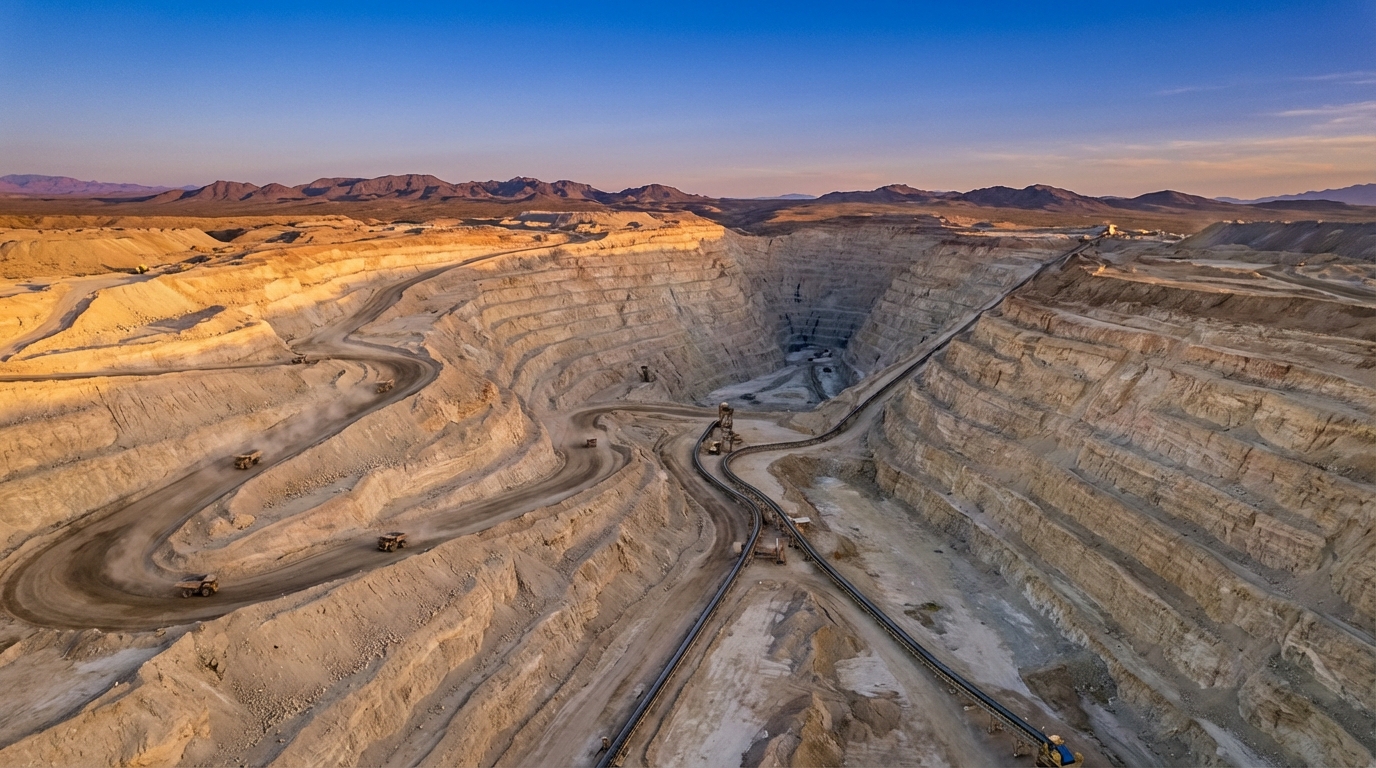
These reserves are not concentrated in a single district. The Mountain Pass mine in California, operated by MP Materials, is the flagship deposit and currently the only major producing rare earth mine in the country. Additional prospective resources exist in Wyoming, Texas, Alaska, and other states, spanning carbonatites, ion-adsorption clays, and by-product streams from phosphate and titanium operations. Many of these remain in the resource or early feasibility stage and are highly sensitive to processing route economics and permitting expectations.
On the production side, USGS reporting has cited US rare earth mine output in the range of roughly 50,000 metric tonnes per year in recent years, against an estimated global production of about 390,000 tonnes. That puts the US around a low double-digit percentage share of global mine supply, which appears respectable until contrasted with processing and end-product capacity, where US participation is markedly lower. The apparent reserve life, if calculated naively as reserves divided by annual production, seems comfortable-but this metric is misleading when the choke point lies further down the value chain.
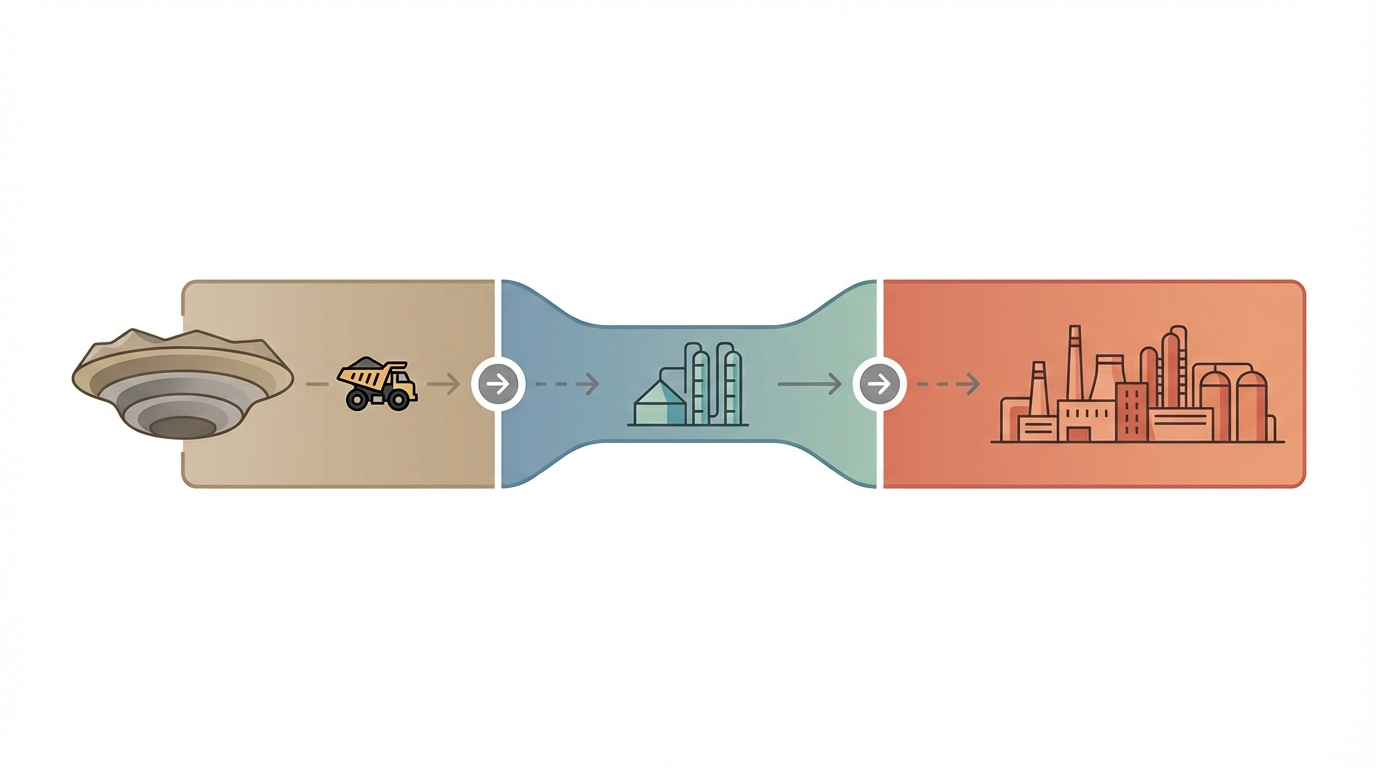
The core mismatch is this: US rare earth mining capacity is approaching strategic relevance, while US rare earth processing capacity remains strategically negligible. The ore is there, and some of it is already being dug, crushed, and concentrated. What is missing is domestic conversion of that concentrate into separated oxides, metals, and magnets at meaningful scale.
2. How Rare Earths Move Through the US Value Chain Today
In operational terms, the contemporary US rare earth value chain is best visualized as a two-stage loop. Stage one is domestic: ore extraction and concentration at sites such as Mountain Pass. Stage two is offshore: separation and alloying in Asia, followed by re-import of refined oxides, metals, and magnet components into the US. This out-and-back flow is the structural vulnerability at the heart of the system.
At Mountain Pass, MP Materials mines bastnäsite ore, then crushes, grinds, and beneficiates it through flotation to produce a rare earth concentrate. That concentrate undergoes roasting and leaching on site, yielding a mixed rare earth carbonate or oxide intermediate. Historically, the majority of this intermediate material has been exported—primarily to China—for full separation into individual rare earth oxides and subsequent conversion into metals and magnets. While MP Materials has been re-establishing separation capabilities at Mountain Pass, the US as a whole still relies heavily on foreign separation and downstream processing.
This pattern is visible in trade statistics. Despite domestic mine output, US imports of rare-earth compounds and metals reportedly increased by about 169% in volume in a recent year, even as the total dollar value slipped modestly from roughly $168 million to $165 million. That combination—a sharp rise in physical volumes with a flat-to-lower import bill—indicates two simultaneous dynamics: price compression in the global market and increased dependency on external processors to satisfy growing domestic demand.
From an industrial systems lens, this arrangement embeds three distinct risks. First, it exposes domestic manufacturers of electric vehicle motors, wind turbines, electronics, and defense systems to foreign policy and export control decisions over which they have no influence. Second, it erodes process know-how: the US loses feedback loops between end-user technical specifications and process optimization that tend to cluster where separation and magnet-making occur. Third, it anchors the cost structure of US rare-earth-intensive products to offshore environmental and labor arbitrage rather than domestic process optimization.
3. Processing Technologies and the US Infrastructure Deficit
Rare earth processing is complex, chemistry-intensive, and unforgiving of shortcuts. This is where the US deficit is most acute. The typical midstream chain from concentrate to separated oxide includes several steps: calcination or roasting of concentrate, acid leaching, impurity removal, separation of individual rare earths (usually by solvent extraction or ion exchange), precipitation of purified products, and calcination to oxides, followed by metal making and alloying where required.
The separation stage is the technical and capital heart of the process. Light rare earths (lanthanum, cerium, praseodymium, neodymium) are chemically similar and require dozens, sometimes hundreds, of solvent extraction stages to achieve high purity. Heavy rare earths (dysprosium, terbium, yttrium, etc.) often demand even more intricate circuits. Each stage requires mixer-settler tanks, organic and aqueous phases, pH control, and extensive process monitoring. Throughput is high-volume, low-grade chemistry, with operating windows that are narrow if product purity in the range of 99.9% or higher is expected.
Building such a plant in the US involves several categories of capital outlay: large-scale SX (solvent extraction) banks or ion exchange columns; reagent storage and handling systems; high-density polyethylene or lined steel tanks for corrosive solutions; effluent treatment facilities; and tailings management infrastructure capable of handling both chemical and radiological hazards. Sector analyses often place required upfront capital in the hundreds of millions of dollars for medium-scale facilities, with project economics highly sensitive to plant utilization, reagent costs, and environmental compliance measures.
Regulation is a further structural factor. Many rare earth ores, especially those rich in monazite, contain elevated levels of thorium and sometimes uranium. Once processed, these can trigger Nuclear Regulatory Commission (NRC) oversight, with stringent requirements for storage, monitoring, and potential disposition of radioactive by-products. The Environmental Protection Agency (EPA) and state authorities regulate air emissions (notably fluorine-bearing species and acid mists), water discharge, and solid waste. As a result, permitting timelines for a greenfield separation facility can extend several years, with open-ended risk around additional conditions imposed during review.
Contrast this with China’s southern and northern rare earth clusters, where solvent extraction facilities sit adjacent to mines, magnet plants, and component factories in integrated industrial zones. Shared infrastructure, existing tailings management systems, and experience curves from decades of operation compress both capital and operating costs. This asymmetry is the core of China’s enduring advantage in rare earths: not just reserves, but accumulated process infrastructure and institutional learning.
4. Sectoral Exposure: Defense, Clean Energy, and Electronics
The gap between US rare earth reserves and domestic processing has direct implications for high-stakes sectors. Rare earths are not simply another industrial input; they sit at the heart of performance-critical components that are difficult to redesign around on short timelines.
In defense, neodymium-iron-boron (NdFeB) and samarium-cobalt (SmCo) permanent magnets are embedded in precision-guided munitions, radar systems, actuators, sonar, and electric drive systems for naval vessels and aircraft. Europium, terbium, and yttrium phosphors underpin night-vision and display technologies. Yttrium-aluminum-garnet (YAG) laser systems rely on rare earth dopants. For many of these applications, substitution pathways are either technologically immature or performance-degrading.
Recognizing this, the US government has been building a limited buffer via the National Defense Stockpile. Procurement documentation has cited acquisitions in the range of hundreds of tonnes of neodymium-praseodymium oxide and several hundred tonnes of NdFeB magnet block, alongside smaller volumes of other strategic materials. These quantities are meaningful for specific defense programs but equate to only a few months of consumption at current or projected demand levels. They mitigate acute short-term shocks; they do not fundamentally resolve midstream structural dependence.
In clean energy and electrification, exposure is even larger in absolute tonnage. A single wind turbine using a direct-drive generator can require hundreds of kilograms of NdFeB magnet material. Battery electric vehicles typically contain on the order of a kilogram of rare earth magnets in traction motors and auxiliary systems, depending on design choices. Scaling EV production into the millions of units per year and deploying thousands of large wind turbines implies continuing growth in US rare earth demand, particularly for neodymium, praseodymium, dysprosium, and terbium.
Consumer and industrial electronics add another layer: hard disk drives, audio systems, sensors, and robotics all rely on compact high-performance magnets and specialty alloys. While per-unit consumption can be small, aggregate demand is significant, and redesigning entire product lines around alternative technologies is slow, costly, and often constrained by physics (for example, energy product limits for ferrite magnets).
From an operational risk standpoint, the conclusion is clear: the US rare earth processing gap is not an abstract supply chain issue; it is a direct constraint on industrial policy objectives in defense, energy transition, and advanced manufacturing. Any disruption in offshore separation capacity would rapidly manifest as shortages of magnet materials and high-purity oxides, long before domestic reserves became relevant.
5. Emerging US Responses and Their Execution Constraints
Over the past several years, a series of initiatives has begun to address the US midstream gap. These efforts cluster around three themes: re-integration of the Mountain Pass complex, parallel development of alternative domestic projects and recycling, and targeted public funding framed as critical minerals and industrial resilience policy.
First, MP Materials and Mountain Pass represent the clearest attempt to rebuild an integrated rare earth value chain on US soil. The company has reinvested in on-site processing, moving beyond simple concentrate exports toward mixed rare earth carbonate and oxide production, and has announced and begun constructing separation capacity intended to produce individual light rare earth oxides at commercial scale. In parallel, MP Materials has moved downstream with a magnet manufacturing facility in Texas focused on supplying neodymium-iron-boron magnets for automotive and other applications. This is a deliberate attempt to capture more of the value chain domestically and reduce the need to export intermediate products.
The execution challenges are non-trivial. Achieving consistent oxide purity within tight impurity specifications for magnet-grade neodymium and praseodymium requires stable solvent extraction performance, reagent control, and effective removal of elements such as iron, calcium, and non-lanthanide contaminants. Magnet plant operations add their own constraints: strip casting, hydrogen decrepitation, jet milling, pressing, and sintering steps must all be tightly controlled to meet coercivity and remanence requirements. Scaling both ends of this chain concurrently raises coordination risks; bottlenecks in oxide supply or quality will propagate into the magnet facility, and vice versa.
Second, a cohort of new and revived US projects targets varied ore types and process routes. Some focus on heavy rare earths in clay-like deposits, seeking to replicate ion-adsorption clay leaching methods used in southern China—albeit under stricter environmental controls. Others look to by-product recovery from phosphates, titanium, or coal ash. There is also growing emphasis on recycling of end-of-life magnets and industrial scrap using hydrometallurgical and direct re-use routes. The advantage of recycling is clear: higher feed grades and fewer radioactivity issues. that said, scaling magnet collection systems, dismantling infrastructure, and specialized recycling plants remains a multi-year effort.
Third, federal agencies have deployed tools oriented around industrial resilience rather than financial return. These include Defense Production Act (DPA) authorities, loan guarantees, grants for demonstration-scale separation facilities, and offtake contracts aimed at underpinning demand visibility. In several cases, public funding has targeted early-stage processing technology (such as alternative solvent systems, membrane separations, or novel ion exchange media) alongside more conventional solvent extraction plants. While the capital amounts in individual awards are often modest relative to total project needs, they can de-risk early engineering and permitting phases.
The common constraint across these tracks is execution under regulatory, social, and technical scrutiny. Rare earth processing has a legacy reputation for environmental damage, largely rooted in poorly managed operations in earlier decades and in jurisdictions with weaker enforcement. US projects must demonstrate not only economic viability but also credible, auditable control over emissions, effluents, and tailings. Any misstep risks reinforcing community opposition and tightening regulatory expectations for the entire sector.

6. Scenarios, Trade-offs, and Failure Modes
Looking ahead, the interplay between reserves, processing infrastructure, and policy produces a limited but consequential set of scenarios for US rare earths. None eliminate dependence on global trade; the question is how much strategic leverage the United States gains or forfeits in each case.
Scenario 1: Upstream growth without midstream breakthrough. In this path, mining and concentrate production expand—at Mountain Pass and potentially at new US deposits—but separation and magnet manufacturing capacity remain constrained by capital, permitting, or technology bottlenecks. The US becomes a larger exporter of intermediate products while still importing most of its finished rare earth materials. The reserve-to-production gap narrows at the mine level but persists, or even widens, at the processing level. This scenario maintains geological relevance but leaves industrial policy objectives heavily exposed to offshore processing decisions.
Scenario 2: Successful light rare earth integration, persistent heavy rare earth dependence. In this configuration, projects such as Mountain Pass plus associated magnet plants achieve reliable, competitive processing of light rare earths—neodymium, praseodymium, lanthanum, cerium—and can supply a material share of domestic demand for EV and wind magnets. However, heavy rare earths (notably dysprosium and terbium), which are essential for high-temperature magnets, remain largely sourced from imports due to the geological distribution of ore types and slower progress on clay and by-product projects. US manufacturing gains partial insulation from shocks but remains dependent on a narrow set of foreign suppliers for critical heavy rare earths.
Scenario 3: Technology shift toward alternative processing and materials. Advances in separation technologies (membrane-based systems, new extractants, or solid-phase sorbents) could lower the capital and environmental barriers to domestic processing, while materials science continues to push magnet designs that reduce or partially substitute rare earth content. Under this scenario, US projects could deploy less waste-intensive separation routes, easing permitting and operating constraints, while end-users redesign products for lower dysprosium or terbium intensity. This would not remove reliance on rare earths, but it would reshape the risk landscape by reducing the most acute single-element exposures.
Across all scenarios, there are common failure modes that recur in project histories:
- Process scale-up gaps: Laboratory or pilot-scale separation flowsheets that fail to translate to commercial throughput due to phase separation issues, crud formation in solvent extraction, or unanticipated impurity behavior.
- Reagent and consumable risk: Dependence on specific extractants, acids, or neutralizing agents whose cost or availability shifts, undermining operating assumptions.
- Tailings and effluent mismanagement: Underestimation of residue volumes or radioactivity leading to overruns on storage facilities, community pushback, or regulatory intervention.
- Social license erosion: Inadequate engagement with local communities and tribal nations, especially where water use and landscape disturbance intersect with existing concerns.
- End-market misalignment: Failure to produce material that meets the exacting specifications of magnet makers or catalyst producers, leading to discounts, reprocessing, or loss of offtake.
Industrial resilience logic therefore revolves less around any single flagship project and more around systemic redundancy: multiple ore types, multiple processing routes, diversified geographic footprints, and continuous feedback between end-user requirements and process design. Reserves alone do not confer security; it is the configuration and robustness of the processing network that determines practical autonomy.
7. Conclusion: From Ore to Autonomy
The phrase “US rare earth reserves” often conjures images of vast untapped mineral wealth waiting to be brought online. The operational reality is less straightforward. The United States does hold around 1.9 million metric tonnes of identified rare earth reserves and operates a globally significant mine at Mountain Pass. Yet, because separation, refining, and magnet manufacturing capacity remain limited, this endowment has not translated into strategic autonomy in critical minerals.
There is progress: MP Materials’ reintegration efforts, emerging projects in non-traditional ore types and recycling, and targeted government support framed around US critical minerals and industrial resilience rather than short-term financial metrics. Still, the risk structure remains defined by a fundamental asymmetry with Chinese and other Asian processing clusters that benefit from existing infrastructure, clustered expertise, and established supply relationships.
For Materials Dispatch, the key analytical signal is no longer whether the US has enough ore. It does. The decisive weak signals lie in permitting decisions for separation projects, demonstrated performance of new processing technologies at scale, long-term offtake contracts that bridge mines to magnet makers, and the evolution of environmental and radiological compliance frameworks. Monitoring these will determine whether US rare earth reserves remain a latent geological statistic—or become the foundation of a robust, domestically anchored rare earth value chain.
Note on Materials Dispatch methodology Materials Dispatch integrates continuous monitoring of technical standards and policy documents (for example, USGS critical minerals reports and Defense Logistics Agency procurement data), market behavior in rare earths and allied metals, and end-use performance requirements in sectors such as EVs, wind, and defense electronics. This triangulation enables a process-first view of US critical minerals security that connects upstream reserves, midstream processing realities, and downstream engineering specifications.


